1. Sine rule
Facts: an angle-side pair is known. Use \(\dfrac{a}{\sin A}=\dfrac{b}{\sin B}\).
Everything here builds on Grade 10/11 — a fast recap before the new Grade 12 content.
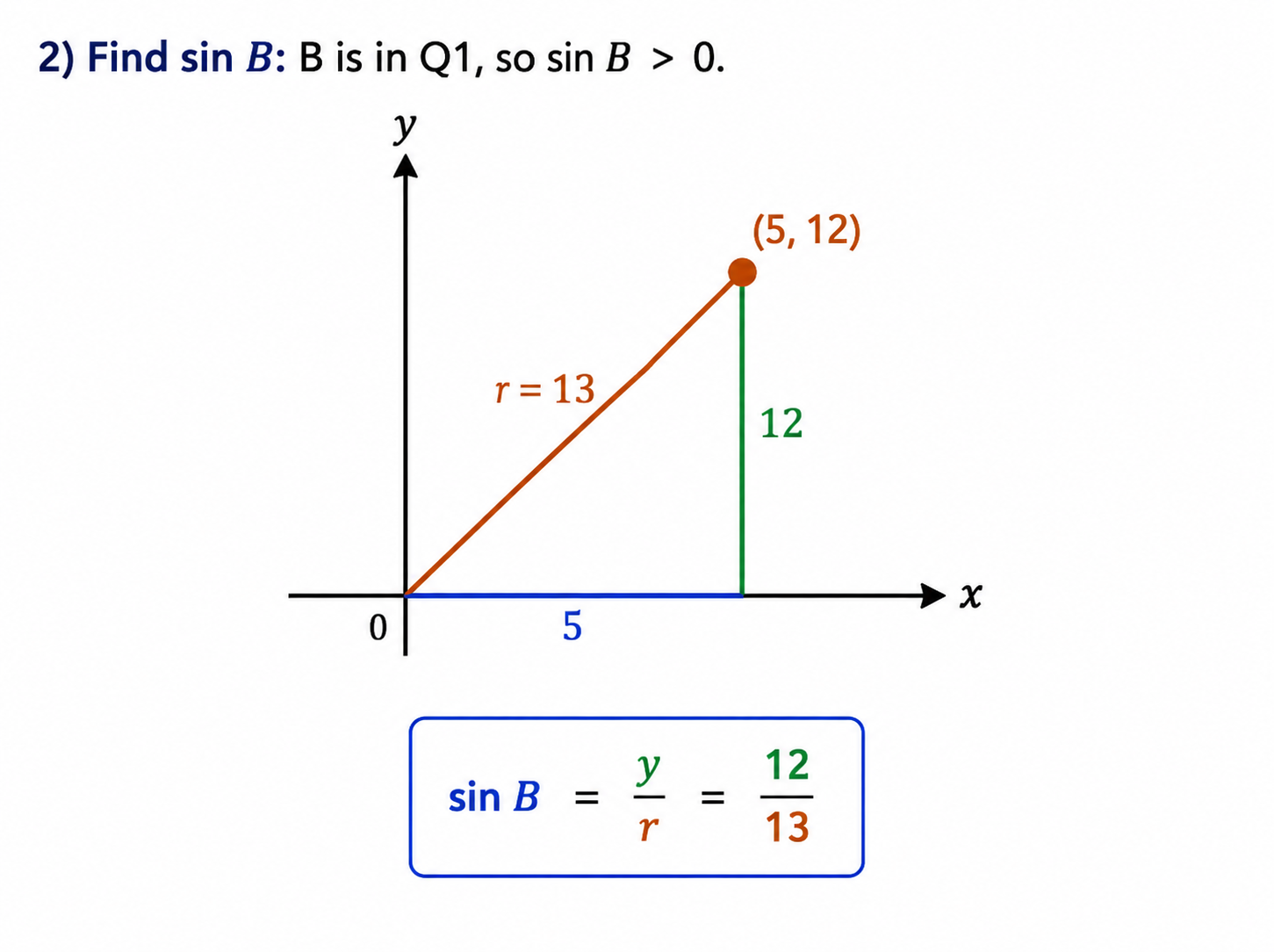
Q1 all +, Q2 sin +, Q3 tan +, Q4 cos +. Reference angle gives the magnitude; CAST gives the sign.
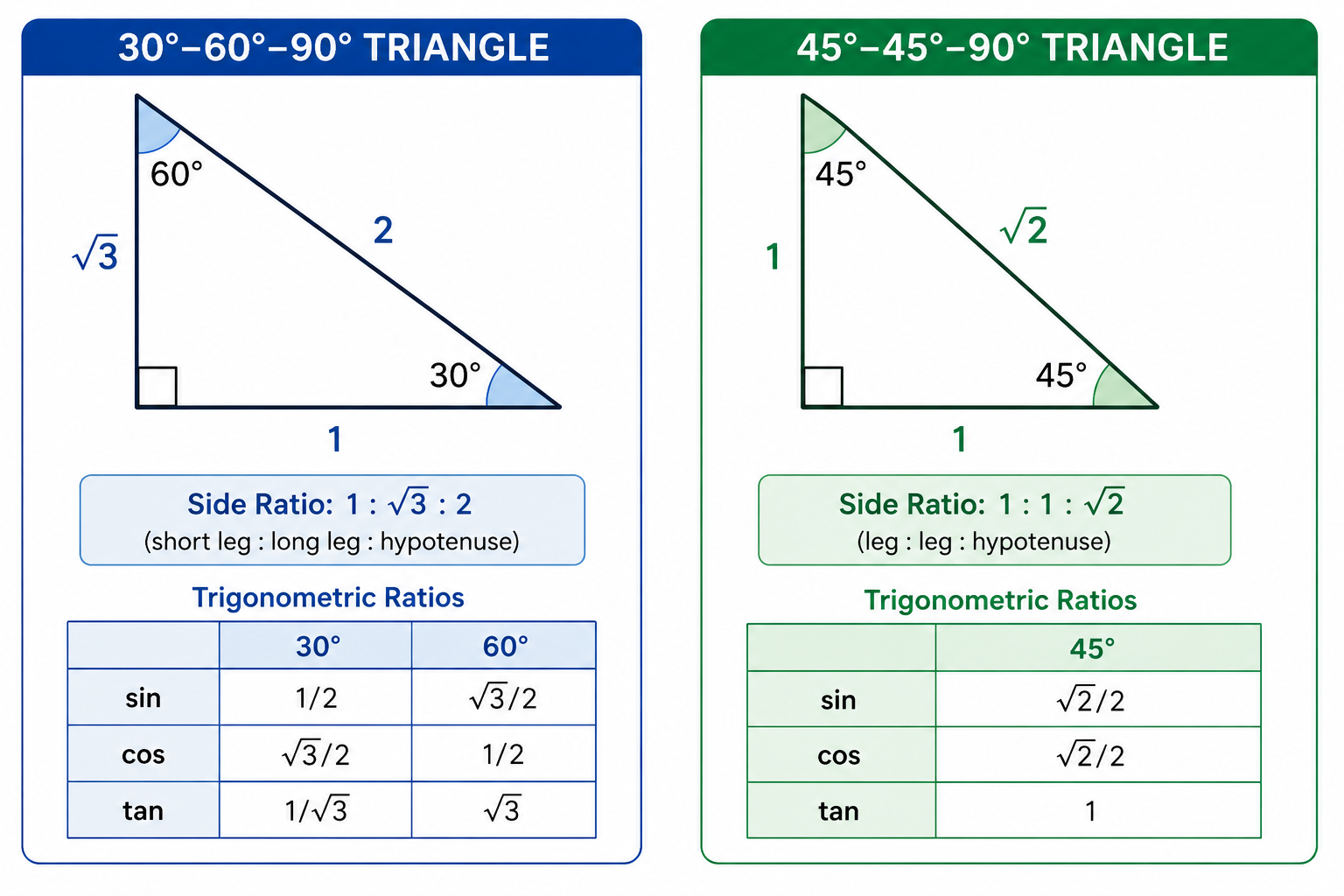
Rebuild \(0°,30°,45°,60°,90°\) from the 30-60-90 and 45-45-90 triangles — never guess.
Given \(\sin\theta=\dfrac35\) and \(\cos\theta=\dfrac45\), determine \(\sin2\theta\).
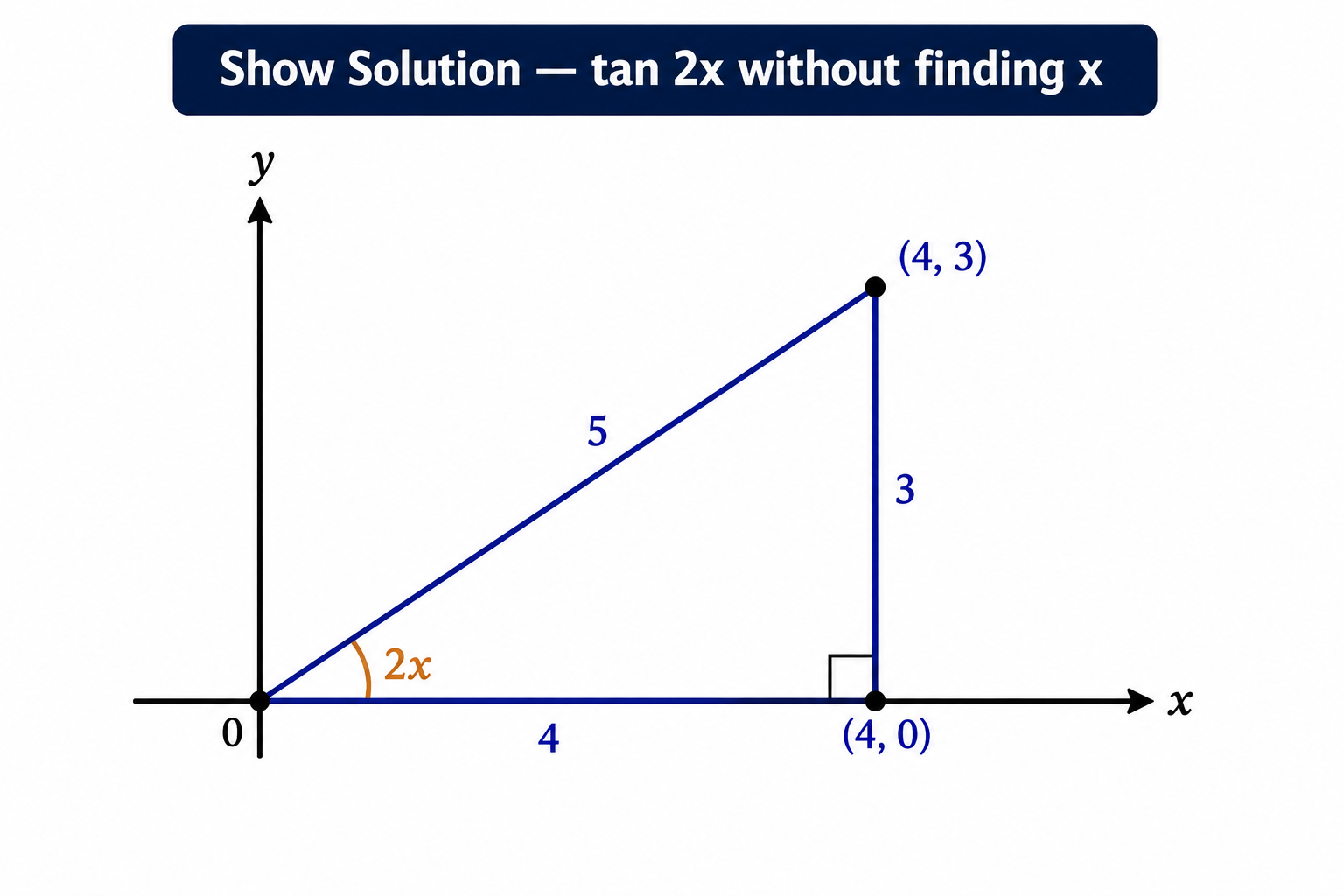
Use the diagram to determine \(\tan2x\).
Solve \(\sin2x=\cos x\) for \(x\in[-180°;360°]\).
\(\sin\alpha=\tfrac35\), \(\alpha\in(90°;180°)\). Find \(\cos2\alpha\).
In \(\triangle ABC\), \(b=8\text{ cm}\), \(c=10\text{ cm}\), and \(\hat A=30°\). Determine the area of the triangle.
In \(\triangle ABC\), \(\hat A=40°\), \(\hat C=65°\) and \(c=12\text{ cm}\). Determine \(a\).
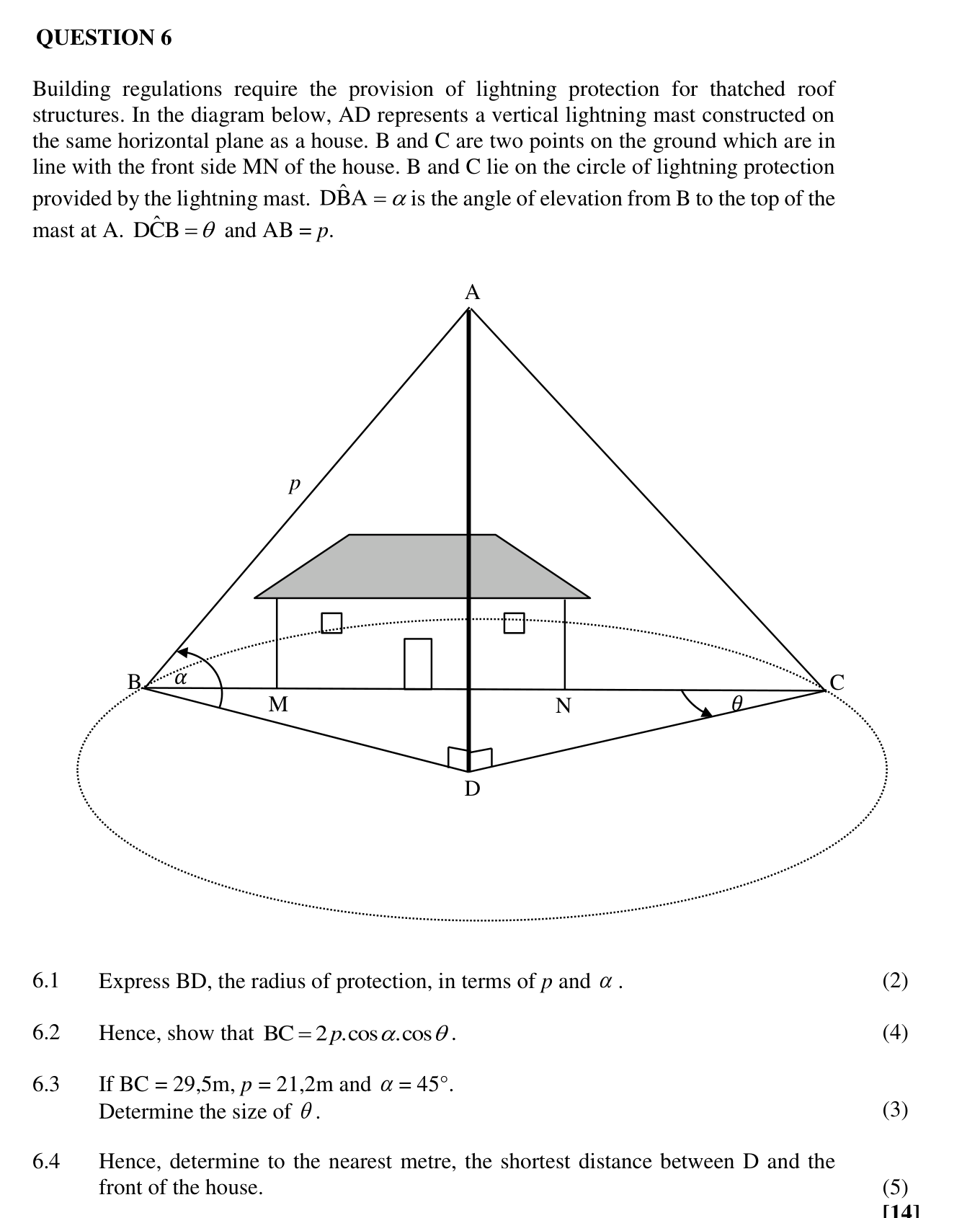
A vertical lightning mast \(AD\) stands over a house; \(B\) and \(C\) are ground points on the mast's circle of protection (centred at \(D\), the foot of the mast). \(\angle DBA=\alpha\) is the angle of elevation from \(B\) to the top of the mast, and \(AB=p\). Since \(BD=DC\) (both radii), \(\angle DBC=\angle DCB=\theta\). Show \(BD=p\cos\alpha\), then \(BC=2p\cos\alpha\cos\theta\); given \(BC=29{,}5\) m, \(p=21{,}2\) m and \(\alpha=45°\), find \(\theta\) and, to the nearest metre, the shortest distance from \(D\) to \(BC\).
A vertical flagpole \(AB\) stands on level ground. From a point \(C\) on the ground, \(20\) m from the base \(B\), the angle of elevation to the top \(A\) is \(35°\). Determine the height \(AB\), correct to one decimal place.
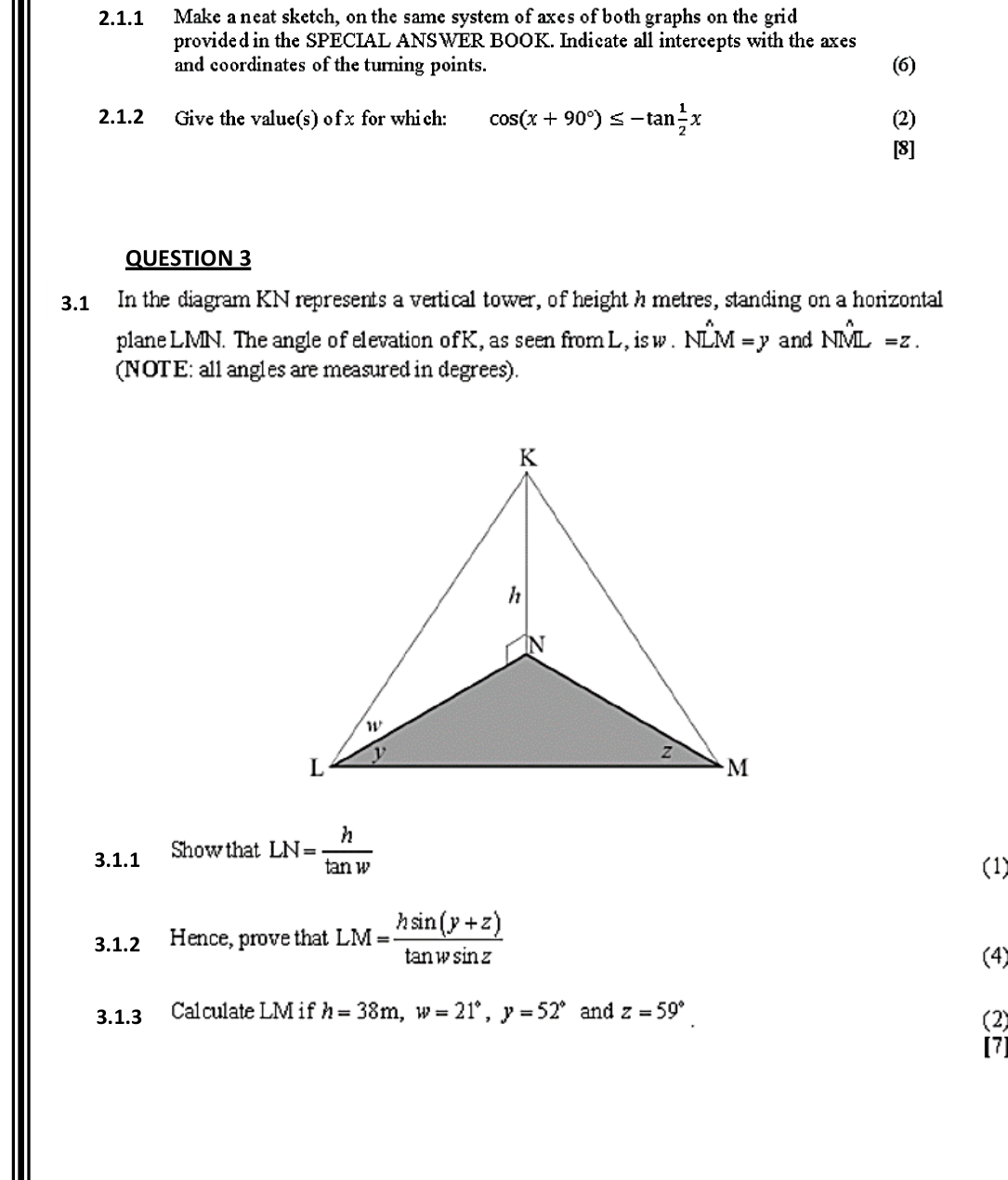
\(KN\) is a vertical tower of height \(h\) on plane \(LMN\). Angle of elevation of \(K\) from \(L\) is \(w\); \(\angle NLM=y\), \(\angle NML=z\). Show \(LN=\dfrac{h}{\tan w}\), hence \(LM=\dfrac{h\sin(y+z)}{\tan w\sin z}\); calculate \(LM\) for \(h=38\) m, \(w=21°\), \(y=52°\), \(z=59°\).
Source status: the question and diagram were checked against the supplied paper; the solution was independently verified because no marking guideline was supplied.
The Grade 12 Trigonometry knowledge statement this page is built from.
Derive and use the sine, cosine and tangent compound-angle identities.
Accept \(\sin2\alpha=2\sin\alpha\cos\alpha\), then derive and use all three forms of \(\cos2\alpha\).
Apply compound and double-angle identities to prove identities and solve trigonometric equations without losing solutions through division.
Revise the proofs of the sine, cosine and area rules before applying them.
Solve linked problems in two and three dimensions.
A few practical notes before you start.
Four free, independent videos — not made by Equation Station SA.
Where the sine and cosine addition formulas come from.
Khan Academy · Proof of angle addition formula for sine
Applying the double angle identities to simplify and solve.
Khan Academy · Double angle formula for cosine example
Using the Pythagorean identity to simplify a trig expression — the core move behind most identity proofs.
Khan Academy · Examples using Pythagorean identities
Solving non-right triangles with the sine rule.
Khan Academy · Law of sines
Choose the skill holding you back, work through another explanation, then return to an exam-style question.
These links open other websites in a new tab. Use Siyavula for the South African grade sequence and the DBE archive for official exam practice. International lessons may include radians or extra topics; follow the degree intervals in your question.
Use a reference angle and quadrant signs to explain each reduction, including negative angles and co-ratios.
Follow the derivation, then try an exact-value example with the working covered. Explain why cosine's addition formula uses a minus sign.
Practise recognising which identity simplifies an expression. Write one justified equality at a time and check denominators.
Identify the equation type, factorise where possible, and list every answer inside the given interval.
Mark the known sides and angles. Check whether you have an opposite pair, an included angle or three sides before selecting a rule.
Separate the vertical and horizontal triangles. Find the shared side, then write down which triangle supplies each equation.
In Desmos, choose Degrees in Graph Settings and set the x-axis from -180 to 360. Compare y=cos(2x) and y=-cos(x); predict their intersections before plotting.
Choose an exam year, then Mathematics Paper 2 and its matching Memo 2. Attempt the trigonometry questions before comparing your working with the marking guideline.
Avoid these errors. They cost marks every year.
Always factorise instead — dividing silently deletes an entire solution family.
\(\cos(A-B)\) adds; \(\cos(A+B)\) subtracts — the reverse of the sin pattern.
It's \(2\sin x\cos x\) — the 2 multiplies the product, not just \(\sin x\).
Work on one side only — cross-multiplying assumes what you're trying to prove.
Always test both \(\theta\) and \(180°-\theta\) when the given angle is acute.
You've done the notes above — now practise and test yourself.
Exam-style Grade 12 questions arranged by level, combining original practice with clearly identified paper-and-memo matches.
Auto-marked quiz with instant feedback, explanations and a complete answer review.
Straight answers to common Grade 12 CAPS questions about trigonometry.
Grade 12 adds compound angle identities, double angle identities, proving identities from first principles, and extends problem-solving from 2D into 3D using the sine, cosine and area rules from Grade 11.
Yes. CAPS explicitly lists proof and use of the compound angle and double angle identities as examinable content.
Work on one side only, usually the more complex side, convert everything to sine and cosine if you get stuck, and look for opportunities to use the Pythagorean, compound angle or double angle identities. Never cross-multiply or move terms across the equals sign.
Dividing can silently delete an entire solution family (wherever that ratio equals zero). Always move everything to one side and factorise instead.
Everything you need to learn the topic is on this page already. Once you've been through the notes above, work through the Mastery Bank, then finish with the Test Your Knowledge quiz as a self-check.