Right Triangles & SOHCAHTOA
Label opposite, adjacent and hypotenuse for each acute angle. Then find one missing side and one missing angle.
Why similar triangles make the ratios work, SOH-CAH-TOA, special angles you can derive without a calculator, extending ratios to any angle with the Cartesian plane, CAST and reference angles, reciprocal ratios, and solving real 2D problems. Notes, a mastery bank and a quiz — everything for this topic is one click away.
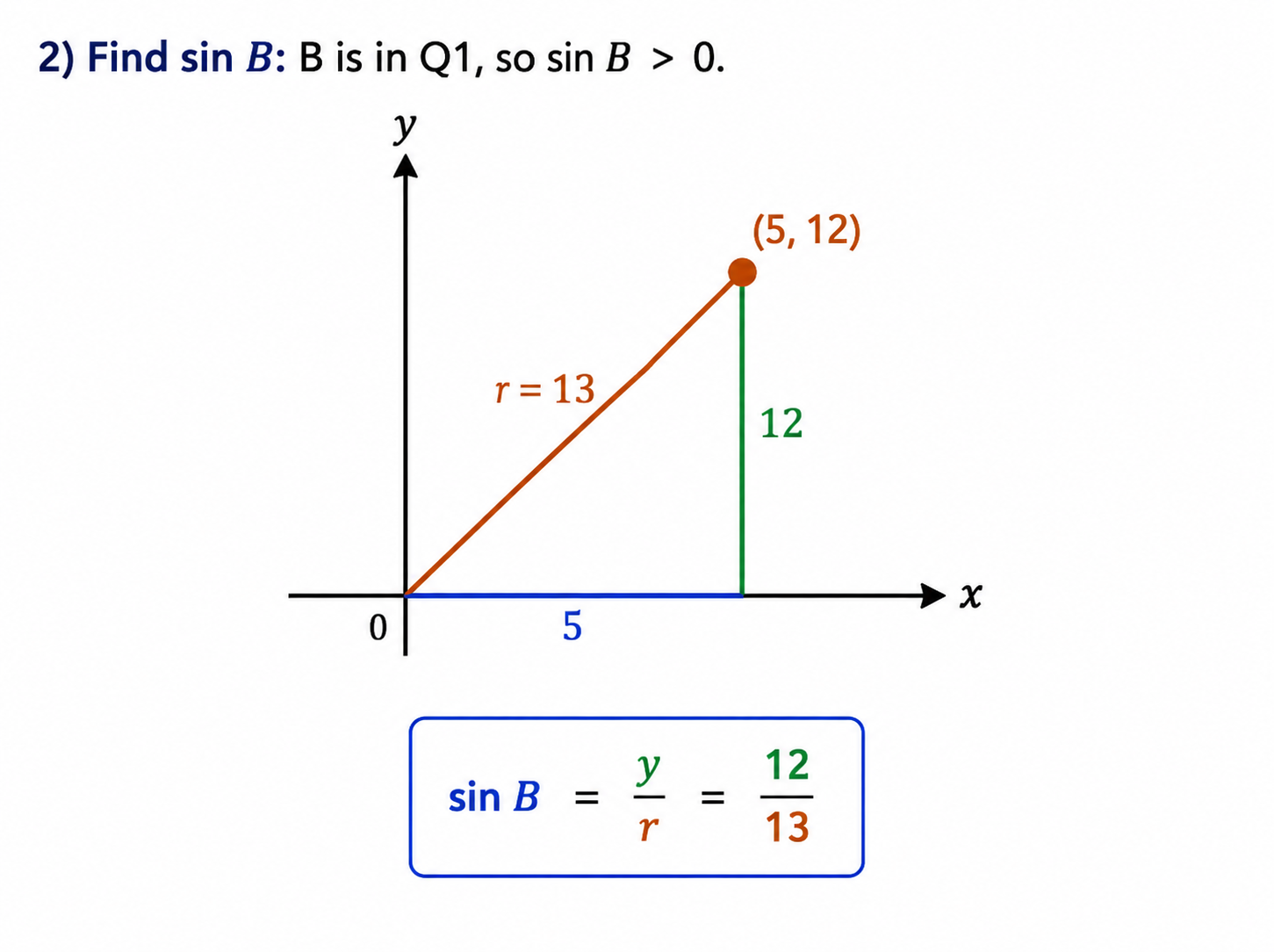
Use the diagram. Point \(B\) is in Quadrant 1. Determine \(\sin B\).
Derived from two simple triangles, not memorised as a table.
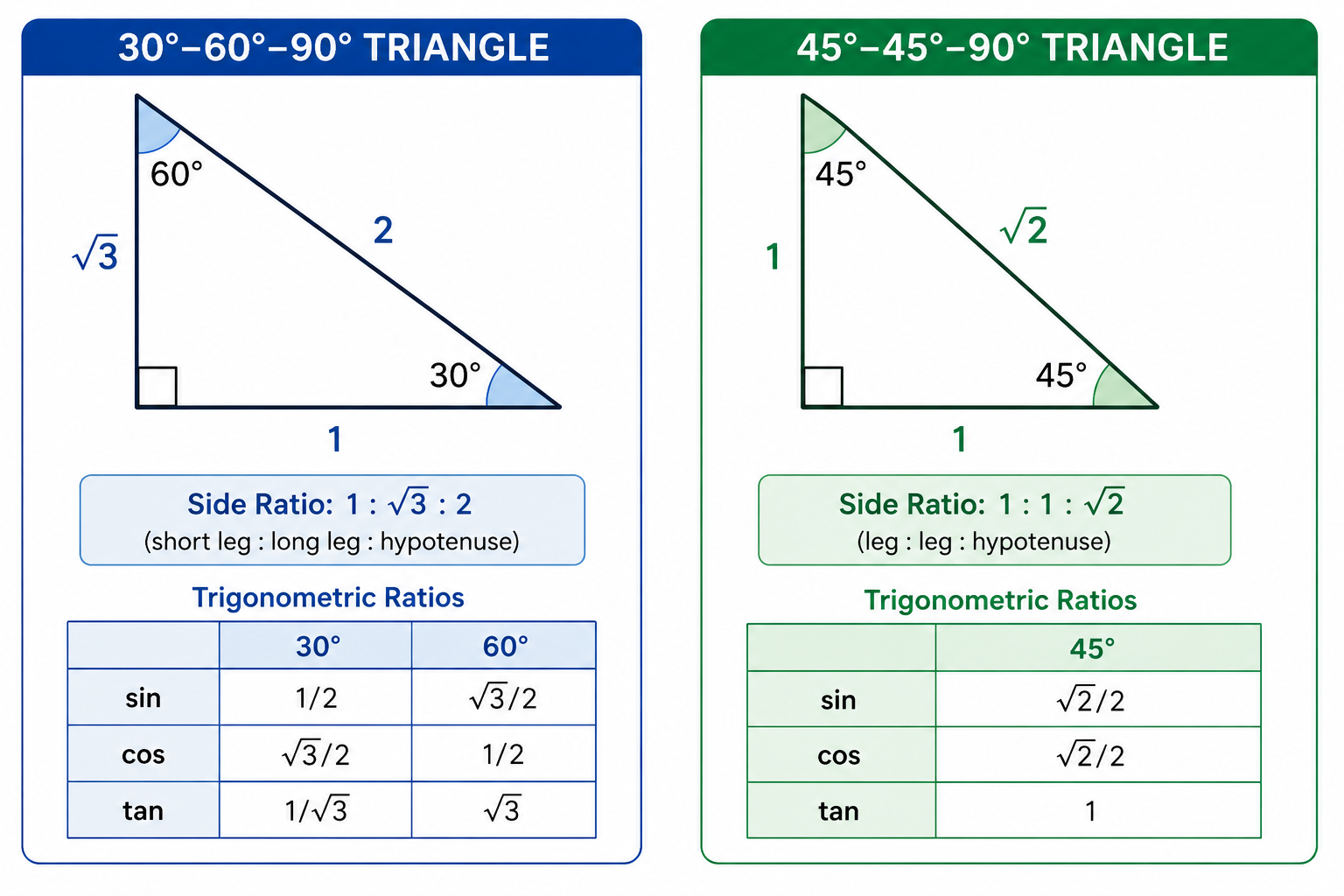
| \(0°\) | \(30°\) | \(45°\) | \(60°\) | \(90°\) | |
|---|---|---|---|---|---|
| \(\sin\) | \(0\) | \(\tfrac12\) | \(\tfrac{\sqrt2}{2}\) | \(\tfrac{\sqrt3}{2}\) | \(1\) |
| \(\cos\) | \(1\) | \(\tfrac{\sqrt3}{2}\) | \(\tfrac{\sqrt2}{2}\) | \(\tfrac12\) | \(0\) |
| \(\tan\) | \(0\) | \(\tfrac{\sqrt3}{3}\) | \(1\) | \(\sqrt3\) | undefined |
Right triangles only go up to 90°. Here's how the ratios extend further.
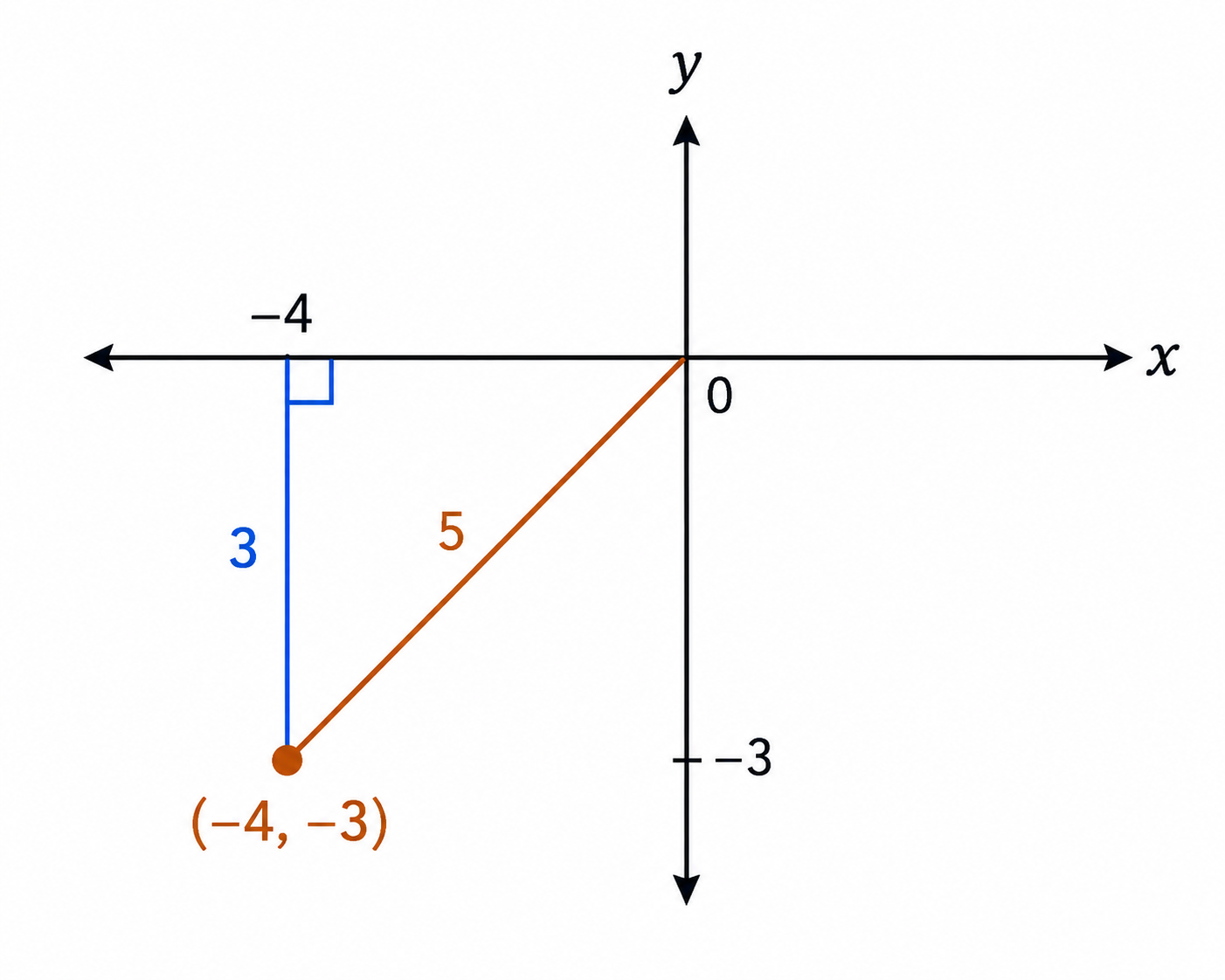
This matches SOH-CAH-TOA exactly when \(\theta\) is between \(0°\) and \(90°\) — it just also works when \(x\) or \(y\) is negative.
Given \(\sin\theta=\dfrac45\) and \(\theta\) is acute (\(0°<\theta<90°\)), determine \(\cos\theta\) and \(\tan\theta\).
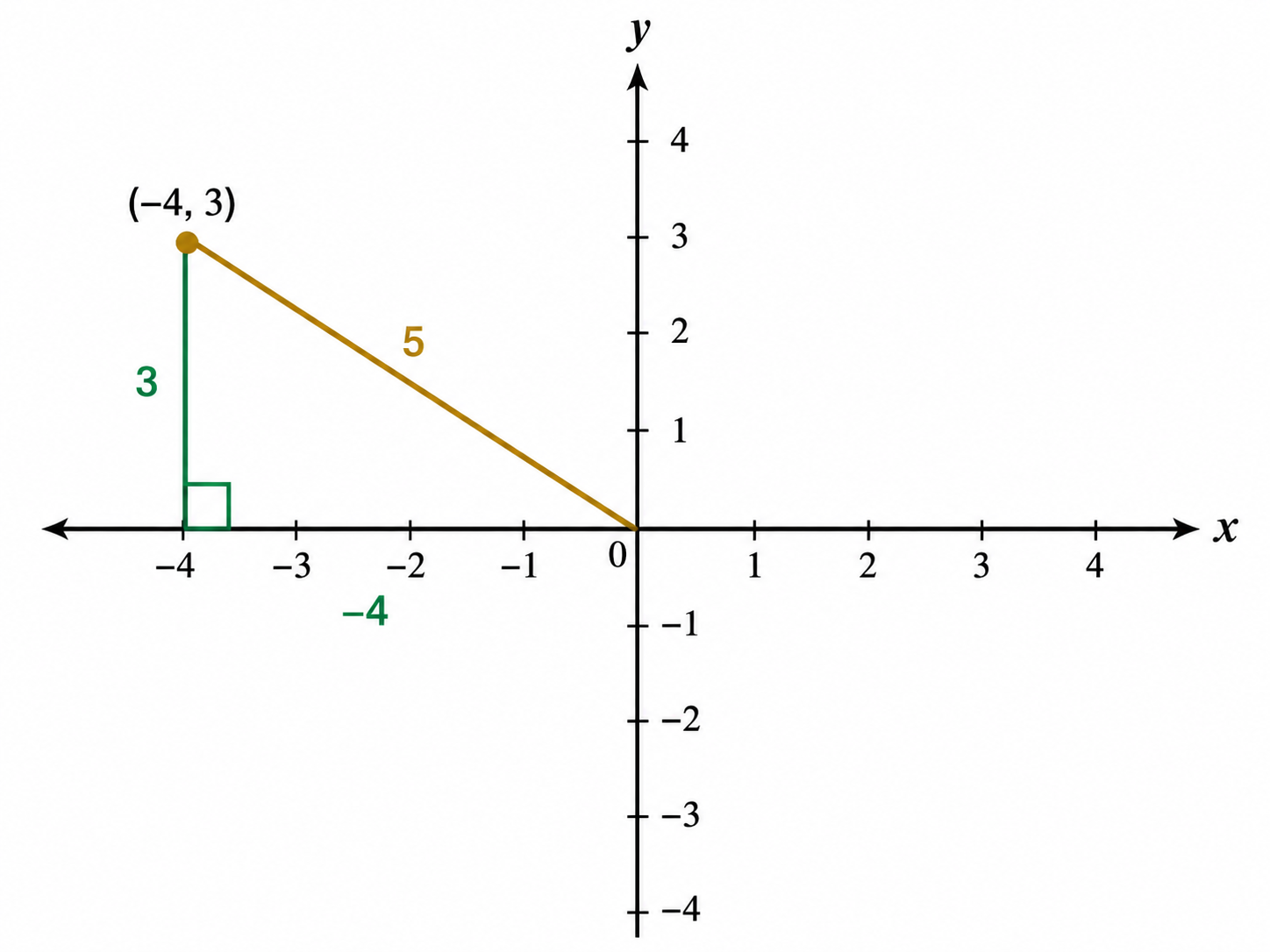
Given \(\sin\theta=\dfrac35\) and \(\theta\) is obtuse (\(90°<\theta<180°\)), determine \(\cos\theta\) and \(\tan\theta\).
Given \(\cos\theta=-\dfrac{5}{13}\) and \(\theta\) is reflex (\(180°<\theta<270°\)), determine \(\sin\theta\) and \(\tan\theta\).
The Grade 10 Trigonometry knowledge statement this page is built from.
Definitions of the trigonometric ratios sin θ, cos θ and tan θ in right-angled triangles.
Extend the definitions of sin θ, cos θ and tan θ to 0°–360°.
Derive and use values of the trigonometric ratios (without a calculator) for the special angles {0°;30°;45°;60°;90°}.
Define the reciprocals of the trigonometric ratios.
Solve simple trigonometric equations in the stated interval and use diagrams to determine values from 0° to 360°.
Plot, sketch and interpret \(y=\sin\theta\), \(y=\cos\theta\) and \(y=\tan\theta\) on \([0^\circ;360^\circ]\), including the effects of \(a\) and \(q\).
Solve problems in two dimensions.
A few practical notes before you start.
Four free, independent videos — not made by Equation Station SA.
Defining sin, cos and tan from a right triangle's sides.
Khan Academy · Basic trigonometry
Deriving exact values from the 30-60-90 and 45-45-90 triangles.
Khan Academy · 45-45-90 triangles
Extending sin, cos and tan using a point's coordinates and radius.
Khan Academy · Introduction to the unit circle
Angles of elevation and depression, worked step by step.
Khan Academy India · Intro to heights and distances
Choose the part you need help with. Try the suggested task, then return to your notes.
These links open other websites in a new tab. Start with Siyavula for South African school examples. Some international lessons use radians; keep your calculator in degrees for the questions on this page.
Label opposite, adjacent and hypotenuse for each acute angle. Then find one missing side and one missing angle.
Use the 30°–60°–90° and 45°–45°–90° triangles to rebuild the exact ratios before checking the answers.
Predict the signs of sine, cosine and tangent at 120°, 210° and 300°. Explain each sign using the coordinates.
Check DEG mode, practise an inverse trig key, and substitute your angle back into the original equation.
Try the tree-height example. Sketch the situation and decide which two sides are involved before choosing a ratio.
In Desmos, open Graph Settings and choose Degrees. Plot y=sin(x), y=cos(x) and y=tan(x); set the x-axis from 0 to 360 and compare their zeros.
Avoid these errors. They cost marks every year.
They're only fixed once you've chosen which angle you're working with — relabel them every time the angle changes.
\(\csc\theta\) pairs with \(\sin\theta\), not \(\cos\theta\) — the "co-" naming is misleading.
Re-derive from the 30-60-90 / 45-45-90 triangles if you forget — guessing risks an easy mark.
Only \(x\) and \(y\) change sign between quadrants — \(r=\sqrt{x^2+y^2}\) is a distance, never negative.
Both are measured from the horizontal line, not from the vertical side of the triangle.
The reference angle is always acute (\(0°\)–\(90°\)) and measured to the x-axis — it's a tool for finding the SIZE of a ratio, not the answer to "what is \(\theta\)?".
You've done the notes above — now practise and test yourself.
Exam-style Grade 10 questions arranged by level, combining original practice with clearly identified paper-and-memo matches.
Auto-marked quiz with instant feedback, explanations and a complete answer review.
Straight answers to common Grade 10 CAPS questions about trigonometry.
Grade 10 Trigonometry starts from similar triangles (why the ratios only depend on the angle), then defines sin, cos and tan as ratios of sides in a right-angled triangle, their reciprocals, exact values for special angles, extending the ratios to angles up to 360 degrees using the Cartesian plane (the CAST diagram) and reference angles, and solving 2D problems like angles of elevation and depression. Equation-solving stays within 0–90 degrees this year — the full 0–360 degree case is Grade 11.
Any two right triangles that share an acute angle are similar, so their corresponding sides are in constant proportion. That's why sin, cos and tan give the same value for a given angle no matter how big or small the triangle is.
No. CAPS requires you to derive and use the exact values for 0, 30, 45, 60 and 90 degrees from a 30-60-90 triangle and a 45-45-90 triangle, without a calculator.
It shows which of sin, cos and tan are positive in each quadrant of the Cartesian plane, once angles are extended beyond 90 degrees.
The reference angle is the acute angle between an angle's terminal arm and the x-axis. It gives the size of a ratio from the special-angle table, while the CAST diagram gives its sign — together they let you evaluate any ratio from 0 to 360 degrees without a calculator.
Everything you need to learn the topic is on this page already. Once you've been through the notes above, work through the Mastery Bank, then finish with the Test Your Knowledge quiz as a self-check.
Common mistakes include mixing up which side is opposite versus adjacent, forgetting that reciprocal ratios flip the fraction, guessing special-angle values instead of deriving them, and forgetting that angles of elevation and depression are measured from the horizontal, not the vertical.