Functions, Relations and Inverses
Before you sketch any family, be clear about what a function is and how an inverse is formed.
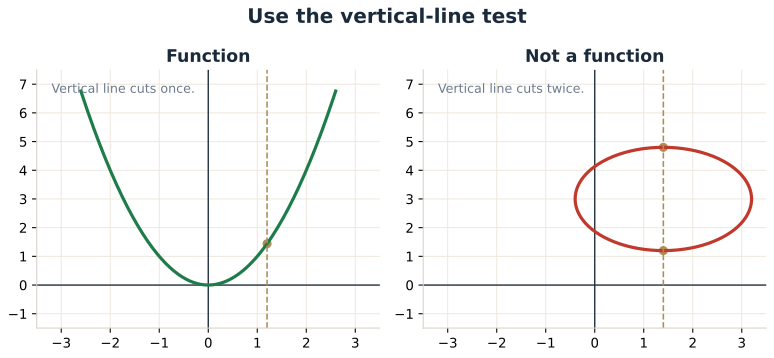
A function is a rule where each x-value gives only one y-value.
If a vertical line touches the graph twice, it is not a function.
Domain is the set of allowed x-values. Range is the set of resulting y-values.
An inverse reverses the mapping. On a graph, it is a reflection in \(y=x\), so domain and range swap.
If the original graph is not one-to-one, you must restrict the domain before its inverse can also be a function.
Straight Lines
Start with the intercept, then use the gradient to place a second point.
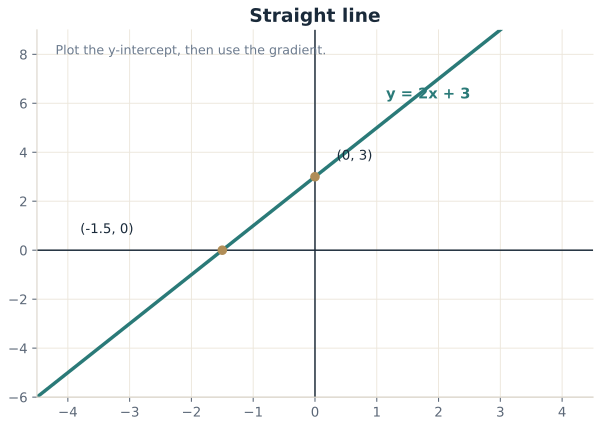
- \(m\) is the gradient
- \(c\) is the y-intercept
- \(m > 0\): line rises to the right
- \(m < 0\): line falls to the right
- \(m = 0\): horizontal line
- Plot \((0,c)\)
- Use the gradient for a second point
- x-intercept
- y-intercept
Sketch the line \(f(x)=2x+3\) and state both intercepts.
Show solution
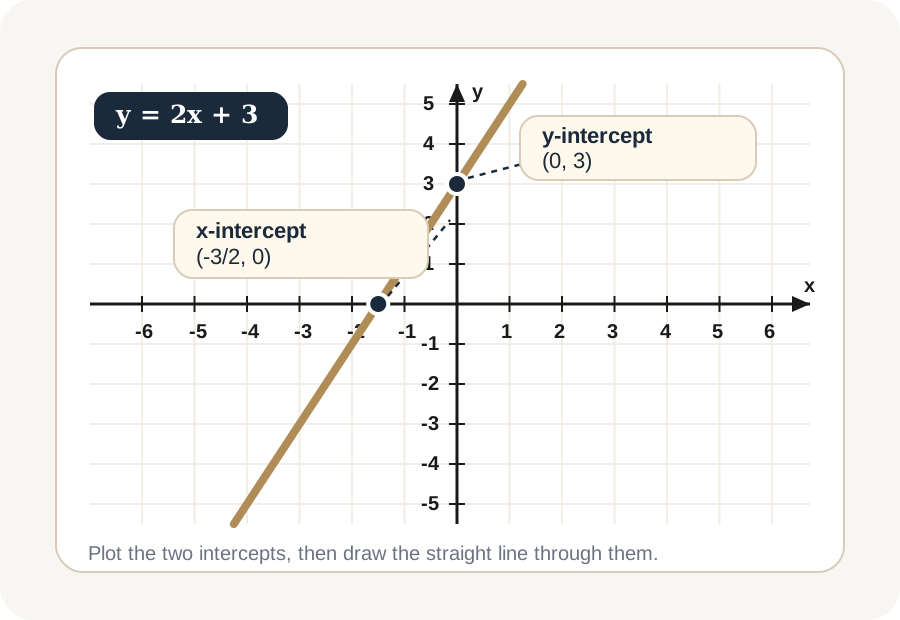
- 1Find the y-intercept by letting \(x=0\): \(y=2(0)+3=3\). So the graph crosses the y-axis at \((0,3)\).
- 2Find the x-intercept by letting \(y=0\): \(0=2x+3 \Rightarrow x=-\tfrac{3}{2}\). So the graph crosses the x-axis at \(\left(-\tfrac{3}{2},0\right)\).
- 3Plot \((0,3)\) and \(\left(-\tfrac{3}{2},0\right)\), then draw one straight line through the two points.
A line passes through \((-1,9)\) and \((3,-3)\). Determine its equation, then state both intercepts.
Show solution
- 1Find the gradient using both points: \(m=\dfrac{y_2-y_1}{x_2-x_1}=\dfrac{-3-9}{3-(-1)}=\dfrac{-12}{4}=-3\).
- 2Substitute \(m=-3\) and the point \((3,-3)\) into \(y-y_1=m(x-x_1)\): \(y-(-3)=-3(x-3)\).
- 3Expand and simplify: \(y+3=-3x+9 \Rightarrow y=-3x+6\). So \(\boxed{f(x)=-3x+6}\).
- 4y-intercept: let \(x=0\): \(y=6\), so \((0,6)\). x-intercept: let \(y=0\): \(0=-3x+6 \Rightarrow x=2\), so \((2,0)\).
Quadratic Graphs
The turning point and the axis of symmetry control the whole parabola.
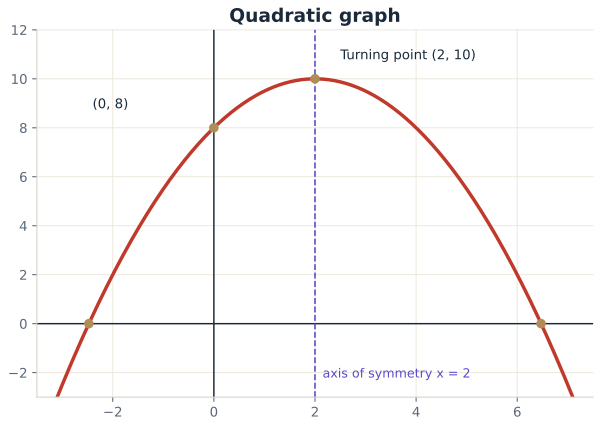
This form shows the turning point immediately.
- \(a > 0\): opens up
- \(a < 0\): opens down
- Plot turning point
- Find one or two intercepts
- Mirror points and draw a smooth curve
For \(f(x)=(x-1)^2-4\), determine the turning point, the y-intercept, and the x-intercepts.
Show solution
- 1The equation is already in turning-point form \(a(x-p)^2+q\), so the turning point is \(\boxed{(1,-4)}\).
- 2y-intercept: let \(x=0\): \(f(0)=(0-1)^2-4=1-4=-3\), so \((0,-3)\).
- 3x-intercepts: let \(f(x)=0\): \((x-1)^2=4 \Rightarrow x-1=\pm2 \Rightarrow x=3\) or \(x=-1\).
A quadratic has turning point \((2,10)\) and y-intercept \((0,8)\). Determine its equation.
Show solution
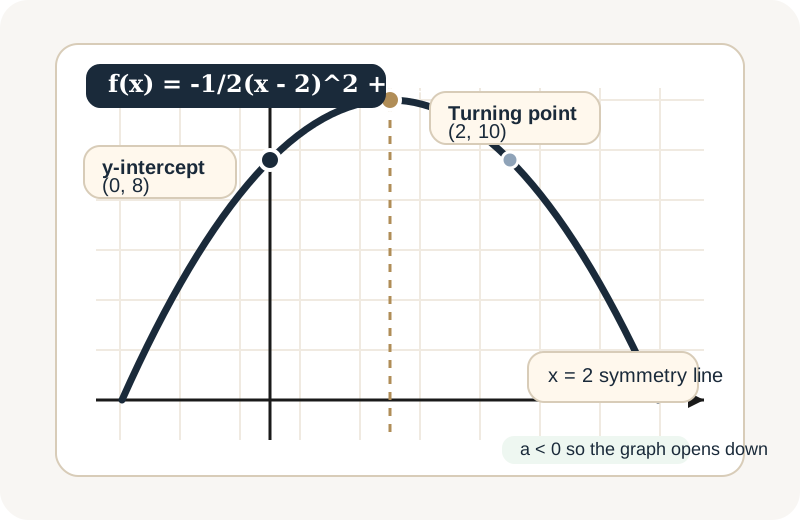
- 1Use turning-point form: \(f(x)=a(x-2)^2+10\).
- 2Substitute the y-intercept \((0,8)\): \(8=a(0-2)^2+10\).
- 3So \(8=4a+10 \Rightarrow 4a=-2 \Rightarrow a=-\tfrac12\).
- 4Therefore, \(\boxed{f(x)=-\tfrac12(x-2)^2+10}\).
Hyperbolas
For a hyperbola, the asymptotes come first. The branches are drawn around them.
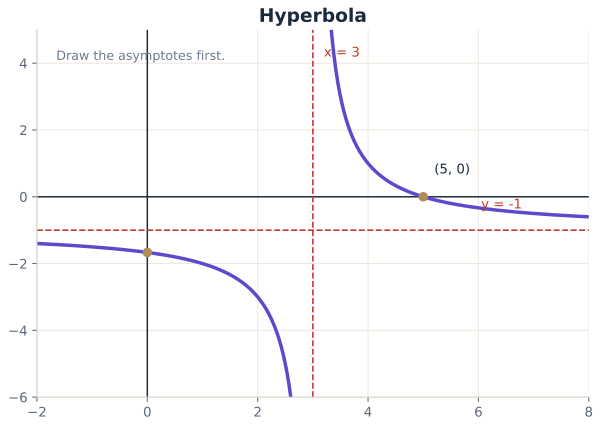
Vertical asymptote: \(x=p\). Horizontal asymptote: \(y=q\).
- \(a>0\): branches top-right and bottom-left
- \(a<0\): branches top-left and bottom-right
Domain: \(x \in \mathbb{R},\; x \ne p\). Range: \(y \in \mathbb{R},\; y \ne q\).
- draw both asymptotes
- find intercepts or one anchor point
- draw both arms without touching the asymptotes
For \(f(x)=\dfrac{2}{x-3}-1\), write down the asymptotes, the x-intercept, the domain, and the range.
Show solution
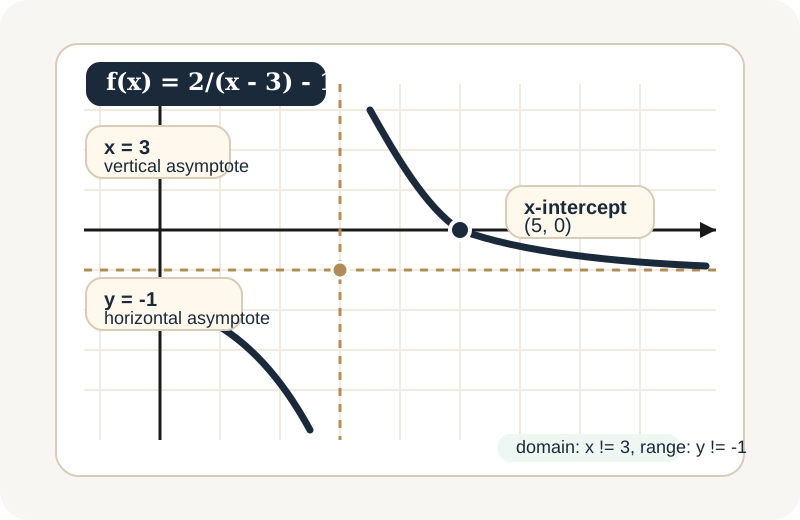
- 1From \(y=\dfrac{a}{x-p}+q\), the asymptotes are \(x=3\) and \(y=-1\).
- 2For the x-intercept, let \(y=0\): \(0=\dfrac{2}{x-3}-1\).
- 3Then \(\dfrac{2}{x-3}=1 \Rightarrow x-3=2 \Rightarrow x=5\). So the x-intercept is \((5,0)\).
- 4Domain: \(x \in \mathbb{R}, x \neq 3\). Range: \(y \in \mathbb{R}, y \neq -1\).
Exponential Graphs
Exponential graphs are controlled by a horizontal asymptote and the growth or decay pattern.
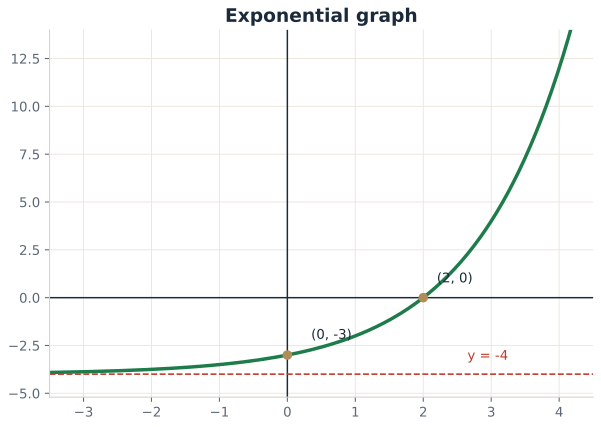
\(y=ab^{x-p}+q\), where \(b>0\) and \(b\neq1\)
Horizontal asymptote \(y=q\). No vertical asymptote.
- \(b>1\): growth
- \(0<b<1\): decay
- domain is all real numbers
- range depends on \(a\) and \(q\)
Given \(h(x)=2^x-4\), determine the asymptote, intercepts, and range.
Show solution
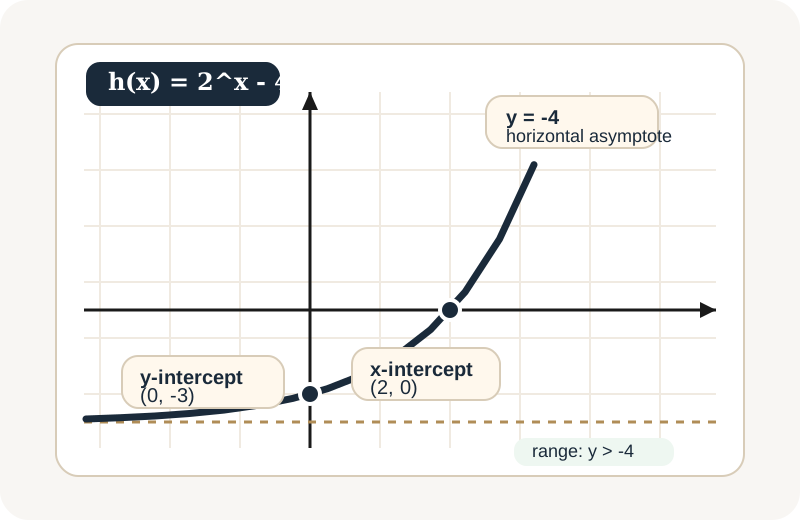
- 1The asymptote is \(y=-4\).
- 2y-intercept: \(h(0)=2^0-4=1-4=-3\), so \((0,-3)\).
- 3x-intercept: \(0=2^x-4 \Rightarrow 2^x=4=2^2\), so \(x=2\), giving \((2,0)\).
- 4Because the graph lies above the asymptote, the range is \(y>-4\).
Logarithmic Graphs
A logarithmic graph is the inverse of an exponential graph, so it can be read as a reflection in \(y=x\).
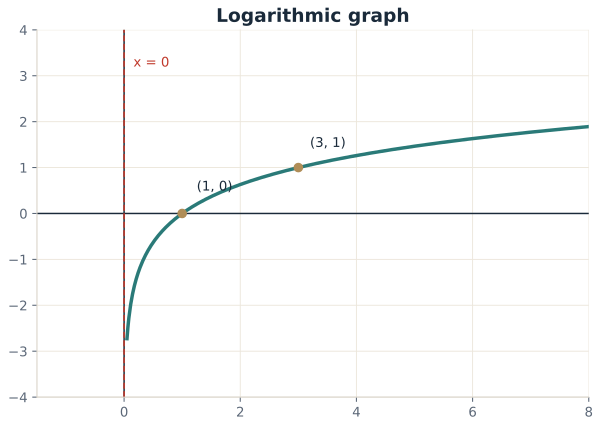
Vertical asymptote \(x=p\). Domain \(x>p\).
- passes through \((1,0)\)
- if \(b>1\), increases; if \(0<b<1\), decreases
\(y \in \mathbb{R}\)
If \(g(x)=3^x\), write the inverse in the form \(y=\ldots\), then state the x-intercept and asymptote of the inverse.
Show solution
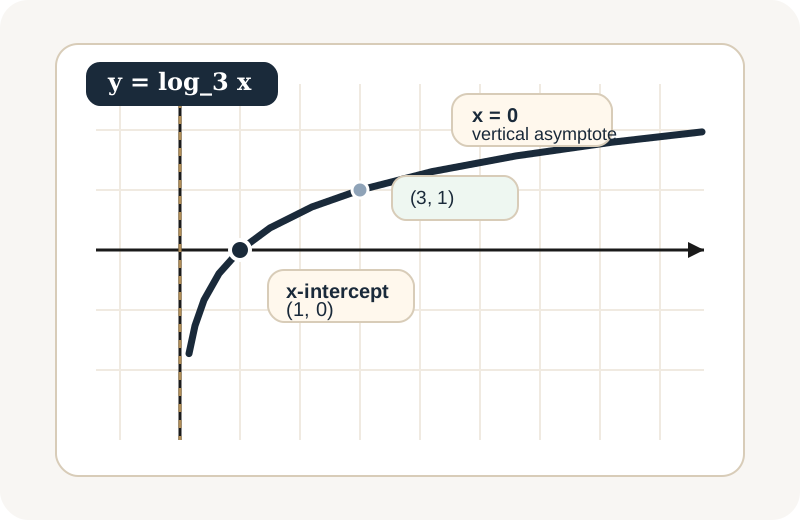
- 1Write \(y=3^x\), swap \(x\) and \(y\): \(x=3^y\).
- 2Solve for \(y\): \(\boxed{y=\log_3 x}\).
- 3x-intercept: \(0=\log_3 x \Rightarrow x=1\), so \((1,0)\).
- 4The inverse has vertical asymptote \(x=0\).
Inverse Functions
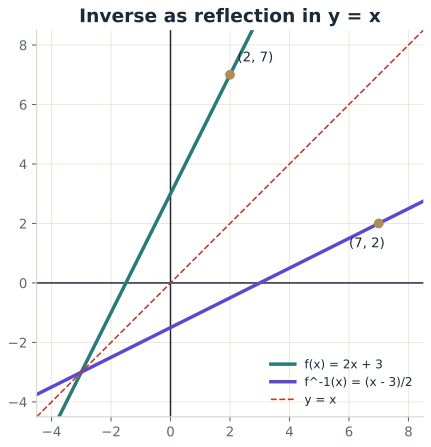
Think in two ways at once: algebraically by swapping \(x\) and \(y\), and graphically by reflecting in \(y=x\).
Write \(y=f(x)\).
Swap \(x \leftrightarrow y\).
Solve for \(y\).
Reflect the graph in \(y=x\): \((x,y)\mapsto(y,x)\).
A full quadratic does not have a functional inverse until the domain is restricted: \(x\geq p\) or \(x\leq p\).
Find the inverse of \(f(x)=4x-8\).
Show solution
- 1Write \(y=4x-8\).
- 2Swap \(x\) and \(y\): \(x=4y-8\).
- 3Solve for \(y\): \(x+8=4y \Rightarrow \boxed{f^{-1}(x)=\dfrac{x+8}{4}}\).
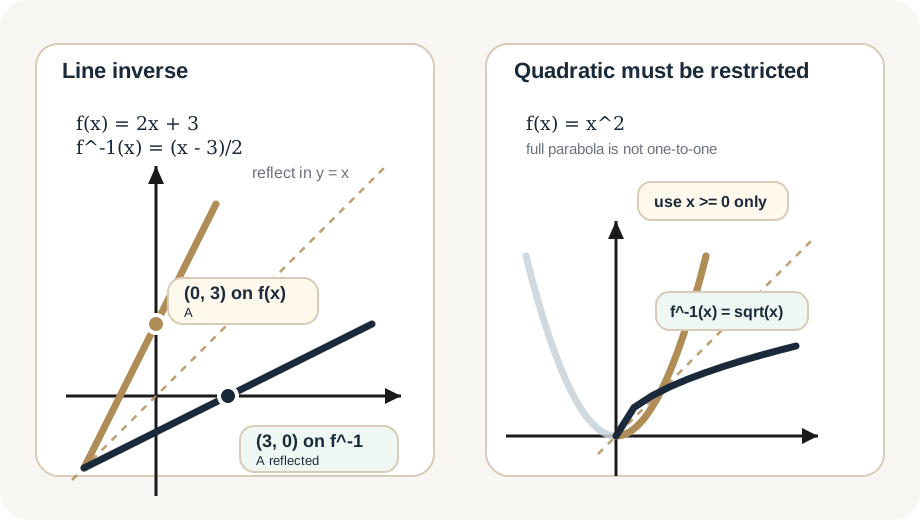
Find the inverse of \(f(x)=2x+3\). Also explain why the inverse of \(f(x)=x^2\) is not a function unless the domain is restricted.
Show solution
- 1Write \(y=2x+3\).
- 2Swap \(x\) and \(y\): \(x=2y+3\).
- 3Solve for \(y\): \(x-3=2y \Rightarrow y=\dfrac{x-3}{2}\). So \(\boxed{f^{-1}(x)=\dfrac{x-3}{2}}\).
- 4For \(f(x)=x^2\): swap \(x\) and \(y\) to get \(x=y^2\), so \(y=\pm\sqrt{x}\) — one x-value gives two y-values, so this is not a function.
- 5If the original domain is restricted to \(x\geq0\), the inverse becomes \(\boxed{f^{-1}(x)=\sqrt{x}}\), which is a function.
Transformations
Transformations move a known graph without changing its family.
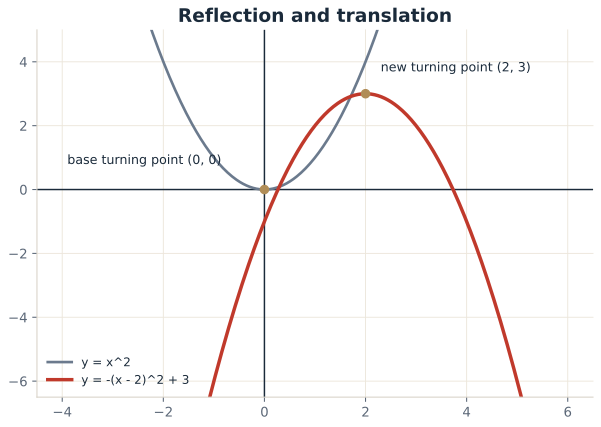
\(y=f(x)+q\): move up/down by \(q\).
\(y=f(x-p)\): move right/left by \(p\).
\(y=-f(x)\): reflect in the x-axis.
\(y=f(-x)\): reflect in the y-axis.
\(y=af(x)\): vertical stretch/compression.
Describe the transformation from \(y=x^2\) to \(y=-(x-2)^2+3\).
Show solution
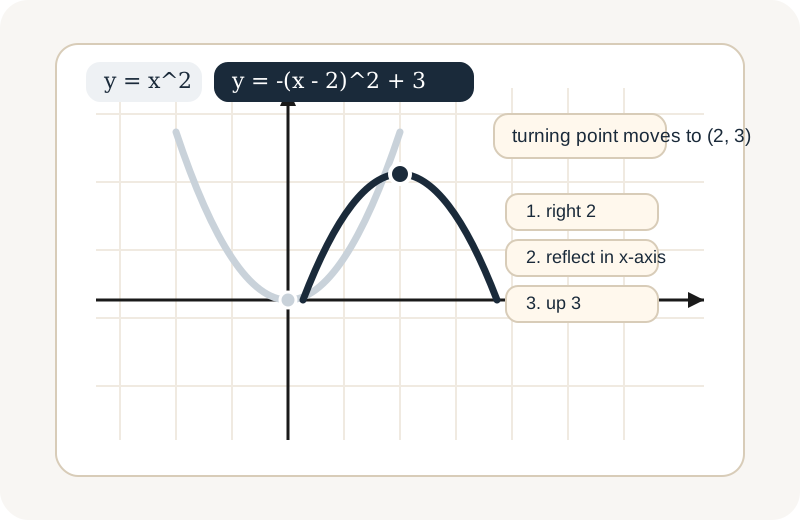
- 1\((x-2)\) means shifted 2 units right.
- 2The negative sign means reflected in the x-axis.
- 3\(+3\) outside means shifted 3 units up.
- 4Full description: right 2, reflect in the x-axis, up 3.
Reading Graphs, Domain, Range and Average Gradient
Once the graph is sketched, most exam questions become interpretation questions.
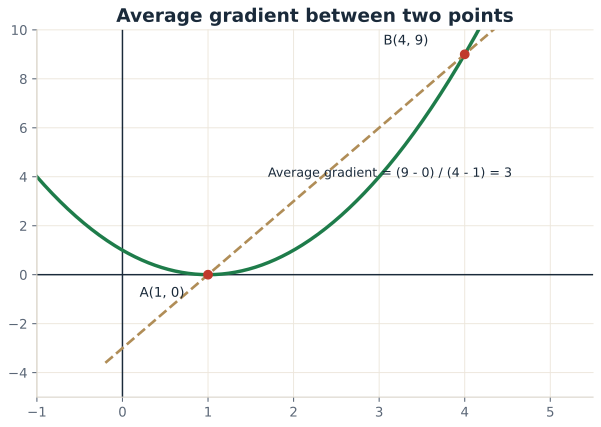
Read domain left to right on the x-axis. Read range bottom to top on the y-axis.
- x-intercept: let \(y=0\)
- y-intercept: let \(x=0\)
Two graphs intersect where their equations are equal — solve simultaneously.
\(\displaystyle m=\frac{y_2-y_1}{x_2-x_1}\). This is not the derivative.
For \(f(x)=x^2-4\), determine the x-intercepts and the y-intercept.
Show solution
- 1y-intercept: let \(x=0\). \(f(0)=0-4=\boxed{-4}\), so \((0,-4)\).
- 2x-intercepts: let \(f(x)=0\). \(x^2-4=0 \Rightarrow x^2=4 \Rightarrow x=\pm2\).
- 3So the x-intercepts are \(\boxed{(-2,0)}\) and \(\boxed{(2,0)}\).
The points \(A(1,0)\) and \(B(4,9)\) lie on a curve. Determine the average gradient between the two points.
Show solution
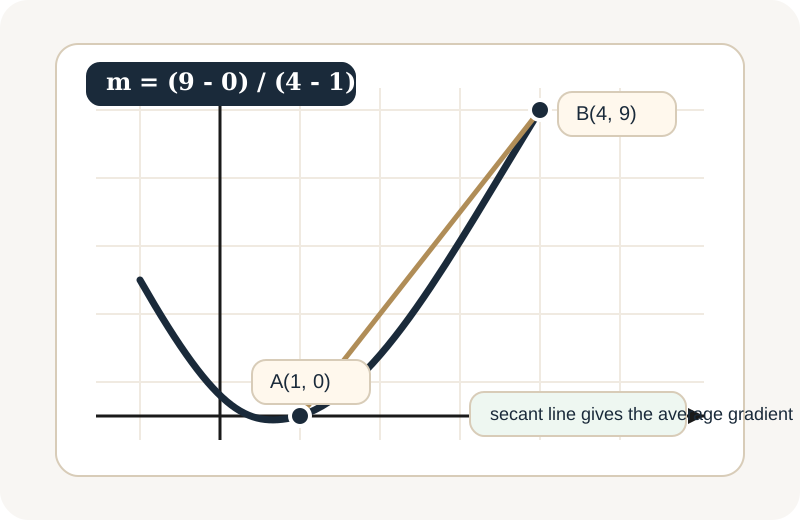
- 1Use \(\displaystyle m=\frac{y_2-y_1}{x_2-x_1}\).
- 2Substitute: \(\displaystyle m=\frac{9-0}{4-1}=\frac{9}{3}=3\).
- 3Therefore, the average gradient is \(\boxed{3}\).
What CAPS Expects You to Know
The Grade 12 Functions knowledge statements this page is built from.
- 1
Determine whether a relation is a function, identify its domain and range, and understand how restricting a domain affects its inverse.
- 2
Sketch and interpret straight-line, quadratic, hyperbolic, exponential and logarithmic graphs, including finding intercepts and other key features from a given equation.
- 3
Determine the equation of a function from its graph or from given key features such as a turning point, intercepts, or asymptotes.
- 4
Investigate and describe the effect of parameters (shifts, reflections, stretches) on the graph of a known function.
- 5
Determine the equation of the inverse of a function algebraically, and sketch it as a reflection in the line \(y = x\).
- 6
Determine the average gradient between two points on a curve, and interpret graphs to solve intercept and intersection problems.
How to Use This Lesson
A few practical notes before you start.
- Start with the sketching routine, then work through the graph families one at a time.
- Finish with inverse functions, transformations, and interpretation.
- Before you submit an answer, check: correct graph family, intercepts and key features, clear labels.
- Try each worked example yourself before pressing “Show solution.”
Functions & Graphs, Family by Family
The trickiest ideas for Grade 12: quadratics in turning-point form, hyperbola asymptotes, the exponential/logarithm inverse pair, and inverse functions. Free, independent short videos — not made by Equation Station SA.
Quadratic Graphs
\(y=a(x-p)^2+q\) — turning point \((p,q)\). Plot the turning point first, then mirror one extra point across the axis of symmetry.
Khan Academy · Graphing a parabola in vertex form
Hyperbolas
\(y=\dfrac{a}{x-p}+q\) — asymptotes \(x=p\) and \(y=q\). Draw both asymptotes before either branch of the curve.
Khan Academy · Finding horizontal and vertical asymptotes
Exponential & Logarithm
\(y=ab^{x-p}+q\) and its inverse \(y=\log_b(x-p)+q\) — a logarithmic graph is an exponential graph reflected in \(y=x\).
Khoza Explains · Log and Exponential Functions Inverses Grade 12
Inverse Functions & Transformations
Swap \(x\) and \(y\), solve for \(y\) — and remember, a full quadratic needs a restricted domain before its inverse is a function.
Smart Culture Education · Functions, Inverse Functions and Graphs
Common Exam Mistakes
Avoid these errors. They cost marks every year.
Calling every relation a function
Check whether each input has exactly one output. Use the vertical-line test for graphs instead of guessing from the shape.
Forgetting the restricted domain for an inverse
A quadratic or similar graph may need a restricted domain before its inverse becomes a function.
Missing asymptotes, intercepts, or turning points
Paper 1 sketches must show the key features clearly. A correct shape without labels can still lose marks.
Reading transformations backwards
Inside the brackets affects horizontal movement and often works in the opposite direction learners expect.
Practise This Topic
You've done the notes above — now practise and test yourself.
Exam-style Grade 12 Functions questions arranged by cognitive level, with real citations from the DBE/provincial archive.
Auto-marked 22-question quiz with a clear report and printable certificate.
Frequently Asked Questions
Straight answers to common Grade 12 CAPS questions about functions, relations, inverse graphs, and the most important things to remember for Paper 1.
What are Functions and Graphs in Grade 12 Maths?
Functions and Graphs in Grade 12 CAPS includes functions and relations, inverse graphs, domain and range, graph transformations, and the sketching of linear, quadratic, hyperbolic, exponential, and logarithmic graphs.
How do I tell if a relation is a function?
A relation is a function if each input has only one output. For graphs, use the vertical-line test: if any vertical line cuts the graph more than once, it is not a function.
What should I remember first for Functions & Graphs?
Start with function vs relation, domain and range, inverse rules, asymptotes, turning points, and transformation language. Those ideas keep returning in different question styles.
Why must I restrict the domain for some inverse functions?
You restrict the domain when the original function is not one-to-one. This makes sure the inverse also passes the function test.
Which resource should I open first for this topic?
Everything you need to learn the topic is on this page already. Once you've been through the notes above, work through the Past Papers, then finish with the Test Your Knowledge as your final self-check.
How do Functions and Graphs appear in CAPS exams?
CAPS exams usually test whether relations are functions, graph sketching, domain and range, inverse functions, transformations, and interpretation of intersections and asymptotes. These questions are central to Paper 1.