Home Topics Trigonometry

Trigonometry

Compound and double angle identities, proving identities, solving equations, trig graphs, triangle rules, and 2D/3D applications — all built around the CAST diagram. Notes, a mastery bank and a quiz — everything for this topic is one click away.

CAPS alignedGrade 12Paper 2Interactive notes
Guided Course Slides
Quick checks: 0/0
Grade 12 CAPS Mathematics

Trigonometry

Compound and double angle identities, proving identities, solving equations, trig graphs, triangle rules, and 2D/3D applications.

Revision: CAST, Special Angles, Pythagoras

Everything here builds on Grade 10/11 — a fast recap before the new Grade 12 content.
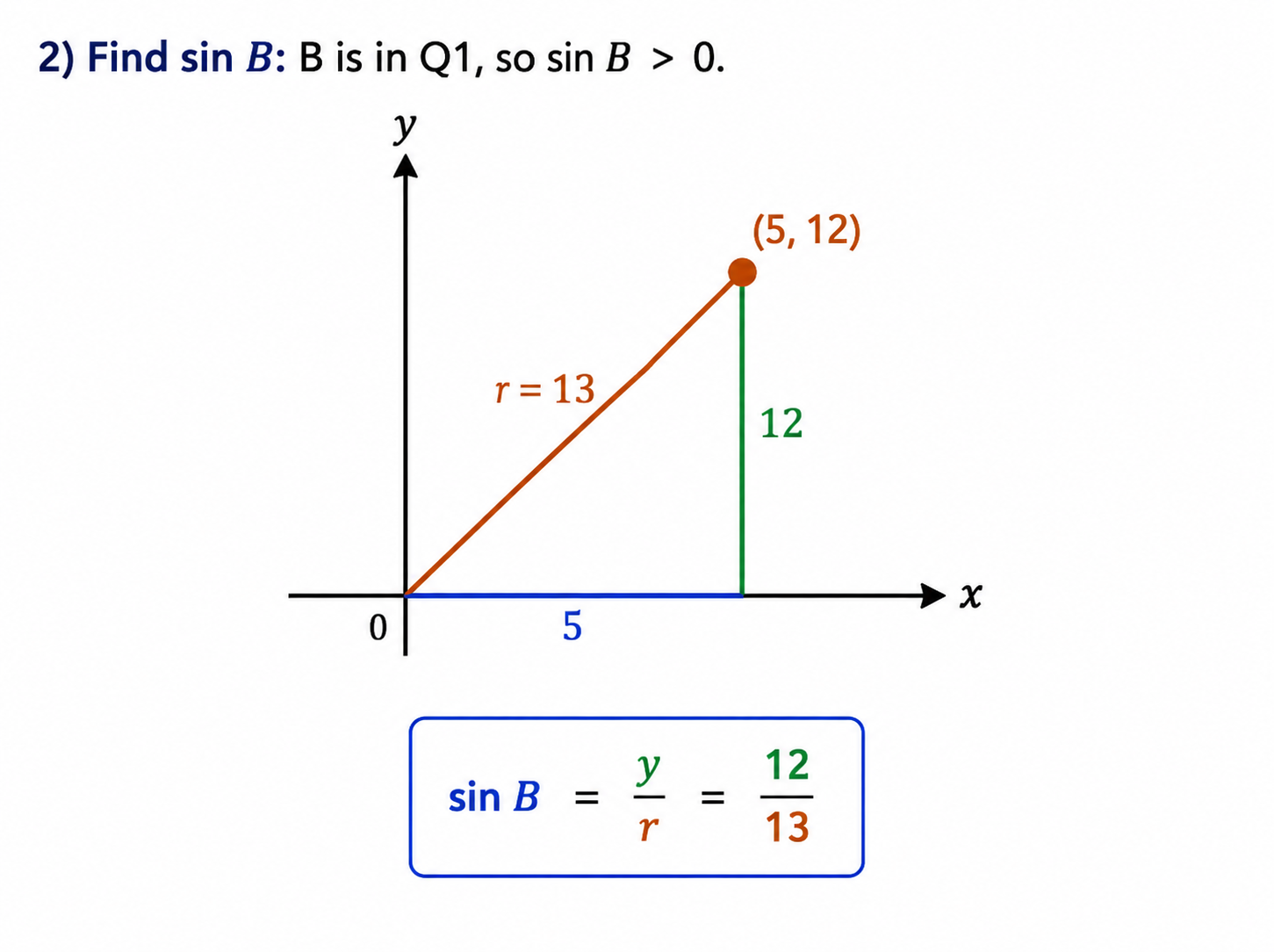
A labelled 5-12-13 coordinate right triangle in Quadrant 1, showing that sine B is 12 over 13.
1. Right triangle: choose the angle, then name opposite, adjacent and hypotenuse before using a ratio.
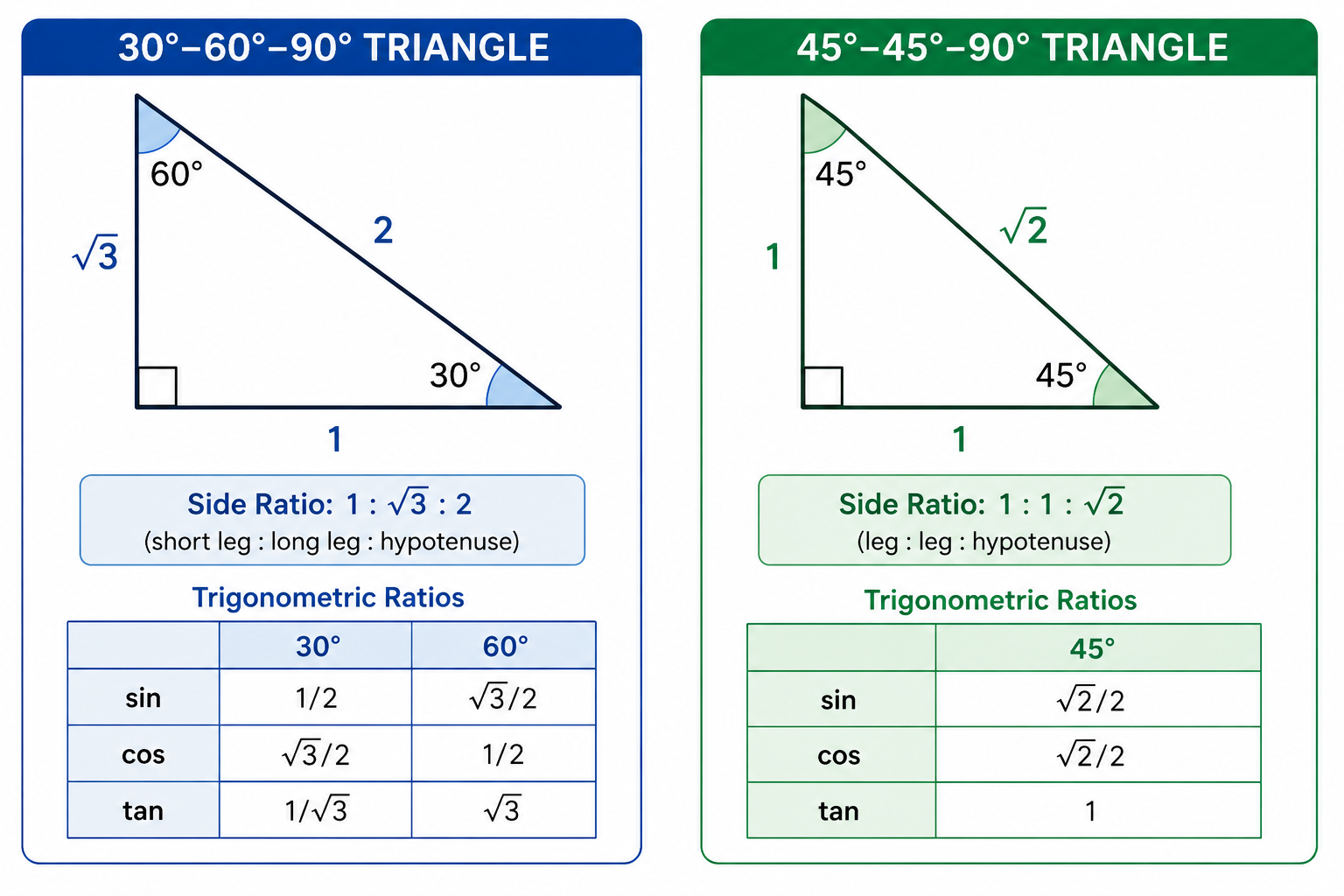
A 30-60-90 triangle and a 45-45-90 triangle with their exact side ratios and special-angle trigonometric ratios.
2. Special triangles: rebuild exact values from \(1:\sqrt3:2\) and \(1:1:\sqrt2\).
The CAST diagram showing which ratio is positive in each quadrant A set of axes dividing the plane into 4 quadrants, labelled A for all positive top right, S for sine positive top left, T for tangent positive bottom left, and C for cosine positive bottom right. A all + S sin + T tan + C cos + 0°/360° 90° 180° 270°
3. CAST: use the reference angle for size, then this sign map for the final answer.
CAST diagram

Q1 all +, Q2 sin +, Q3 tan +, Q4 cos +. Reference angle gives the magnitude; CAST gives the sign.

Special angles

Rebuild \(0°,30°,45°,60°,90°\) from the 30-60-90 and 45-45-90 triangles — never guess.
Pythagorean identity
\[\sin^2\theta+\cos^2\theta=1\]
Diagram first, formula second
Read the labelled picture before selecting a formula: identify the angle and known values, choose the correct ratio or identity, then calculate. This is the same routine you will use in every worked example.
Unit circle definition
On a circle of radius \(r=1\), any point is \(P=(\cos\theta,\sin\theta)\). This replaces SOH-CAH-TOA for angles beyond \(90°\), and is the definition every Grade 12 identity is built from.

Revision: Reduction Formulae & General Solutions

Reflections on CAST, and why sin/cos need two solution families but tan needs one.

\(180°-\theta\)\(180°+\theta\)\(360°-\theta\)\(360°+\theta\)\(-\theta\)
\(\sin\)\(\sin\theta\)\(-\sin\theta\)\(-\sin\theta\)\(\sin\theta\)\(-\sin\theta\)
\(\cos\)\(-\cos\theta\)\(-\cos\theta\)\(\cos\theta\)\(\cos\theta\)\(\cos\theta\)
\(\tan\)\(-\tan\theta\)\(\tan\theta\)\(-\tan\theta\)\(\tan\theta\)\(-\tan\theta\)
Co-ratios — the 90°/270° family
Angles built from \(90°\) or \(270°\) switch ratio name (measuring from the vertical axis): \(\sin(90°-\theta)=\cos\theta\), \(\cos(90°-\theta)=\sin\theta\), \(\tan(90°-\theta)=\cot\theta\). The \(180°\)/\(360°\) family never switches names, only signs.
General solutions, \(n\in\mathbb{Z}\)
\[\sin\theta=k\Rightarrow\theta=\sin^{-1}k+360°n\text{ or }180°-\sin^{-1}k+360°n\]\[\cos\theta=k\Rightarrow\theta=\pm\cos^{-1}k+360°n\qquad\tan\theta=k\Rightarrow\theta=\tan^{-1}k+180°n\]
Full \(90^\circ\pm\theta\) co-ratio recap
ExpressionReduced form
\(\sin(90^\circ-\theta)\), \(\sin(90^\circ+\theta)\)\(\cos\theta\)
\(\cos(90^\circ-\theta)\)\(\sin\theta\)
\(\cos(90^\circ+\theta)\)\(-\sin\theta\)
\(\tan(90^\circ-\theta)\), \(\tan(90^\circ+\theta)\)\(\cot\theta\), \(-\cot\theta\)

Use this as revision, not a substitute for the CAST decision: the sign still comes from the final quadrant.

Quick Check

Simplify \(\cos(180°+\theta)\).

\(\tan(90°-\theta)\) equals:

Compound Angle Identities

The first genuinely new Grade 12 content — and its proof is examinable.

Two points P1 and P2 on a unit circle connected by a chord A unit circle centred at the origin O, with two points P1 at (cos alpha, sin alpha) and P2 at (cos beta, sin beta) on its circumference, connected by a straight chord. The compound angle formula is derived by measuring the length of this chord two different ways: once using the distance formula directly, and once after rotating both points so P2 sits at (1,0). O P₁(cosα, sinα) P₂(cosβ, sinβ) 1
Both points sit on the unit circle (radius 1), so the chord \(P_1P_2\) can be measured two ways — that comparison is the whole proof.
Show derivation of \(\cos(\alpha-\beta)\) (examinable)
  1. 1Place \(P_1(\cos\alpha,\sin\alpha)\) and \(P_2(\cos\beta,\sin\beta)\) on the unit circle. The chord \(P_1P_2\) has \(d^2=(\cos\alpha-\cos\beta)^2+(\sin\alpha-\sin\beta)^2=2-2(\cos\alpha\cos\beta+\sin\alpha\sin\beta)\).
  2. 2Rotate both points so \(P_2\) lands at \((1,0)\) and \(P_1\) lands at \((\cos(\alpha-\beta),\sin(\alpha-\beta))\) — rotation preserves the chord length: \(d^2=(\cos(\alpha-\beta)-1)^2+\sin^2(\alpha-\beta)=2-2\cos(\alpha-\beta)\).
  3. 3Equate the two expressions for \(d^2\): \(\boxed{\cos(\alpha-\beta)=\cos\alpha\cos\beta+\sin\alpha\sin\beta}\). Every other compound formula follows from this one.
The sine and cosine compound identities
\[\cos(\alpha\mp\beta)=\cos\alpha\cos\beta\pm\sin\alpha\sin\beta\]\[\sin(\alpha\pm\beta)=\sin\alpha\cos\beta\pm\cos\alpha\sin\beta\]

Sin: signs match. Cos: signs reverse — the most common error in this section.

Tangent Compound Identities

Derive them from sine and cosine, then protect the denominator.

Both tangent identities
\[\tan(\alpha+\beta)=\frac{\tan\alpha+\tan\beta}{1-\tan\alpha\tan\beta}\qquad\tan(\alpha-\beta)=\frac{\tan\alpha-\tan\beta}{1+\tan\alpha\tan\beta}\]
Derive \(\tan(\alpha+\beta)\) from sine and cosine Level 3
  1. 1\(\tan(\alpha+\beta)=\dfrac{\sin(\alpha+\beta)}{\cos(\alpha+\beta)}=\dfrac{\sin\alpha\cos\beta+\cos\alpha\sin\beta}{\cos\alpha\cos\beta-\sin\alpha\sin\beta}\).
  2. 2Divide the numerator and denominator by \(\cos\alpha\cos\beta\), where the expression is defined.
  3. 3\(\boxed{\tan(\alpha+\beta)=\dfrac{\tan\alpha+\tan\beta}{1-\tan\alpha\tan\beta}}\). Change the signs for the subtraction identity.
Worked example Level 2

Find the exact value of \(\tan75^\circ\).

Show solution
  1. 1Write \(75^\circ=45^\circ+30^\circ\).
  2. 2\(\tan75^\circ=\dfrac{\tan45^\circ+\tan30^\circ}{1-\tan45^\circ\tan30^\circ}=\dfrac{1+\frac1{\sqrt3}}{1-\frac1{\sqrt3}}\).
  3. 3Rationalise or simplify: \(\boxed{\tan75^\circ=2+\sqrt3}\).
Domain check
Do not use either tangent formula when its denominator is zero. This is not a technicality: division by zero means the original tangent expression is undefined.
Worked example — values given directly Level 1

Given \(\sin A=\dfrac35\), \(\cos A=\dfrac45\), \(\sin B=\dfrac5{13}\), \(\cos B=\dfrac{12}{13}\), determine \(\sin(A+B)\).

Show solution
  1. 1Use \(\sin(A+B)=\sin A\cos B+\cos A\sin B\) — every value needed is already given, no quadrant work required.
  2. 2\(\sin(A+B)=\left(\dfrac35\right)\left(\dfrac{12}{13}\right)+\left(\dfrac45\right)\left(\dfrac5{13}\right)=\dfrac{36}{65}+\dfrac{20}{65}\)
  3. 3\(\boxed{\sin(A+B)=\dfrac{56}{65}}\)
Worked example — exact value Level 2

Calculate the exact value of \(\sin75°\).

Show solution
  1. 1Write \(75°=45°+30°\) — both special angles.
  2. 2\(\sin(45°+30°)=\sin45°\cos30°+\cos45°\sin30°=\dfrac{\sqrt2}{2}\cdot\dfrac{\sqrt3}{2}+\dfrac{\sqrt2}{2}\cdot\dfrac12\)
  3. 3\(\boxed{\sin75°=\dfrac{\sqrt6+\sqrt2}{4}}\)
Two Cartesian-plane sketches showing angle A in Quadrant 2 and angle B in Quadrant 1 Left: angle alpha plotted at (-3,4), r=5, in Quadrant 2. Right: angle beta plotted at (12,5), r=13, in Quadrant 1. α (−3,4) r=5 β (12,5) r=13
\(\alpha\) sits in Quadrant II (\(\sin\alpha>0\), \(\cos\alpha<0\)); \(\beta\) sits in Quadrant I (both ratios positive) — each triangle's sides come from \(x^2+y^2=r^2\).
Worked example — with CAST constraints Level 3

Given \(\cos\alpha=-\dfrac35\), \(\alpha\in(90^\circ;180^\circ)\), and \(\cos\beta=\dfrac{12}{13}\), \(\beta\in(0^\circ;90^\circ)\), determine \(\sin(\alpha+\beta)\).

Show solution
  1. 1In Quadrant II, \(\sin\alpha>0\): \(\sin\alpha=\sqrt{1-\cos^2\alpha}=\sqrt{1-\tfrac9{25}}=\tfrac45\).
  2. 2In Quadrant I, \(\sin\beta>0\): \(\sin\beta=\sqrt{1-\cos^2\beta}=\sqrt{1-\tfrac{144}{169}}=\tfrac5{13}\).
  3. 3Use \(\sin(\alpha+\beta)=\sin\alpha\cos\beta+\cos\alpha\sin\beta\).
  4. 4\[\begin{aligned}\sin(\alpha+\beta)&=\left(\dfrac45\right)\left(\dfrac{12}{13}\right)+\left(-\dfrac35\right)\left(\dfrac5{13}\right)\\&=\dfrac{48}{65}-\dfrac{15}{65}=\boxed{\dfrac{33}{65}}.\end{aligned}\]
Quick Check

Which expansion is correct for \(\cos(A+B)\)?

Given \(\cos\alpha=-\tfrac35\), \(\alpha\in(90^\circ;180^\circ)\), and \(\cos\beta=\tfrac{12}{13}\), \(\beta\in(0^\circ;90^\circ)\). Find \(\sin(\alpha+\beta)\).

Double Angle Identities

Set \(\beta=\alpha\) in the compound formulas.

Derivation & all three forms
\[\sin2\alpha=2\sin\alpha\cos\alpha\]\[\cos2\alpha=\cos^2\alpha-\sin^2\alpha=1-2\sin^2\alpha=2\cos^2\alpha-1\]

The last two forms come from substituting \(\sin^2\alpha+\cos^2\alpha=1\).

Which form to use
Want only cos terms? Use \(2\cos^2\alpha-1\). Want only sin terms? Use \(1-2\sin^2\alpha\). See (cos−sin)(cos+sin)? Use \(\cos^2\alpha-\sin^2\alpha\). Choose the form that removes the variable you don't want.
Fatal error
\(\sin2\alpha\neq2\sin\alpha\). The 2 multiplies the product \(\sin\alpha\cos\alpha\), not just \(\sin\alpha\).

Deriving Every Double-Angle Form

This is proof work: every equality must be visible.

Start from \(\alpha+\alpha\)
\[\sin2\alpha=\sin(\alpha+\alpha)\qquad\cos2\alpha=\cos(\alpha+\alpha)\]
  1. 1\(\sin2\alpha=\sin\alpha\cos\alpha+\cos\alpha\sin\alpha=\boxed{2\sin\alpha\cos\alpha}\).
  2. 2\(\cos2\alpha=\cos^2\alpha-\sin^2\alpha\).
  3. 3Replace \(\cos^2\alpha\) with \(1-\sin^2\alpha\): \(\boxed{\cos2\alpha=1-2\sin^2\alpha}\).
  4. 4Replace \(\sin^2\alpha\) with \(1-\cos^2\alpha\): \(\boxed{\cos2\alpha=2\cos^2\alpha-1}\).
Proof mark rule Level 4

If a question says derive or prove, do not quote the final identity. Start from the compound identity, substitute the Pythagorean identity, and write each line of algebra.

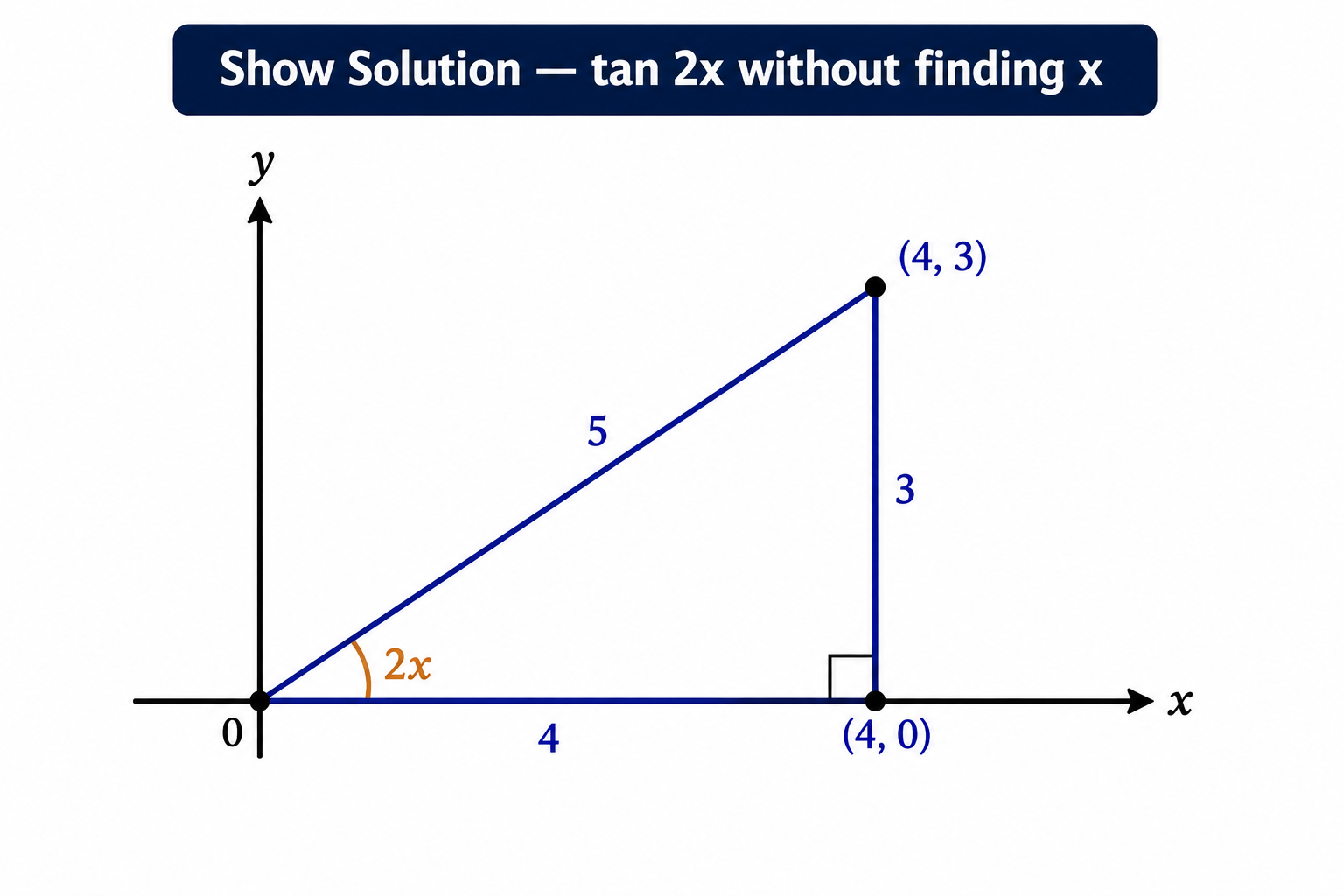
A 3-4-5 right triangle in Quadrant 1 with angle 2x at the origin, adjacent side 4, opposite side 3 and hypotenuse 5.
The diagram labels the angle as \(2x\). Read the sides relative to \(2x\); you do not need to calculate \(x\).
Worked example — values given directly Level 1

Given \(\sin\theta=\dfrac35\) and \(\cos\theta=\dfrac45\), determine \(\sin2\theta\).

Show solution
  1. 1Use \(\sin2\theta=2\sin\theta\cos\theta\).
  2. 2\(\sin2\theta=2\left(\dfrac35\right)\left(\dfrac45\right)=\dfrac{24}{25}\)
  3. 3\(\boxed{\sin2\theta=\dfrac{24}{25}}\)
Worked example — find \(\tan2x\) without finding \(x\) Level 2

Use the diagram to determine \(\tan2x\).

Show solution
  1. 1Use \(2x\) as the angle. Its opposite side is \(3\) and its adjacent side is \(4\).
  2. 2\(\tan2x=\dfrac{\text{opposite}}{\text{adjacent}}=\boxed{\dfrac34}\).
Worked example — equation, factorise don't divide Level 3

Solve \(\sin2x=\cos x\) for \(x\in[-180°;360°]\).

Show solution
  1. 1Expand: \(2\sin x\cos x=\cos x\)
  2. 2Bring to one side and factorise — never divide by \(\cos x\): \(\cos x(2\sin x-1)=0\)
  3. 3Case 1: \(\cos x=0\Rightarrow x=90°+180°n\). In interval: \(x\in\{-90°;90°;270°\}\)
  4. 4Case 2: \(\sin x=\tfrac12\Rightarrow x=30°+360°n\) or \(150°+360°n\). In interval: \(x\in\{30°;150°\}\)
  5. 5\(\boxed{x\in\{-90°;30°;90°;150°;270°\}}\) — dividing by \(\cos x\) would have deleted three solutions.
Worked example — find \(\cos2\alpha\) directly Level 2-3

\(\sin\alpha=\tfrac35\), \(\alpha\in(90°;180°)\). Find \(\cos2\alpha\).

Show solution
  1. 1Use \(\cos2\alpha=1-2\sin^2\alpha\) — no need to find \(\cos\alpha\) at all, avoiding the sign ambiguity.
  2. 2\(=1-2\left(\tfrac35\right)^2=1-\tfrac{18}{25}\)
  3. 3\(\boxed{\cos2\alpha=\dfrac{7}{25}}\)
Quick Check

A proof already has \(\sin^2\theta\) terms. Which form of \(\cos2\theta\) avoids introducing cosine?

Simplify \((\sin\theta+\cos\theta)^2\).

Proving Identities

Golden rules and rescue moves for when you're stuck.

The golden rules
  • Work on one side only — never cross-multiply or move terms across the equals sign.
  • Start with the more complex side — usually the one with fractions or double/compound angles.
  • Convert everything to sin and cos if you get stuck.
  • Write LHS = ... = ... = RHS, and end with a check mark.
Rescue move: conjugate

Multiply \(\dfrac{1}{1-\cos x}\) by \(\dfrac{1+\cos x}{1+\cos x}\) to unlock a Pythagorean simplification.

Rescue move: difference of squares

Spot \(\cos^2x-\sin^2x=\cos2x\), or factor \((\cos x+\sin x)(\cos x-\sin x)\).

Worked example — one identity, one step Level 1

Prove: \((1-\sin x)(1+\sin x)=\cos^2x\)

Show solution
  1. 1LHS \(=1-\sin^2x\) (difference of two squares)
  2. 2\(=\cos^2x=\)RHS \(\checkmark\) (Pythagorean identity)
Worked example — easy Level 2

Prove: \((\sin x+\cos x)^2=1+\sin2x\)

Show solution
  1. 1LHS \(=\sin^2x+2\sin x\cos x+\cos^2x\)
  2. 2\(=(\sin^2x+\cos^2x)+2\sin x\cos x=1+\sin2x=\)RHS \(\checkmark\)
Free State Sept 2022 P2, Q5.4.1 (4 marks) Level 4

Prove: \(\dfrac{2\sin^2x+\sin2x}{\cos2x}=\dfrac{2\sin x}{\cos x-\sin x}\)

Show memo-verified solution
  1. 1LHS \(=\dfrac{2\sin^2x+2\sin x\cos x}{\cos^2x-\sin^2x}\) (expand \(\sin2x\), \(\cos2x\))
  2. 2\(=\dfrac{2\sin x(\sin x+\cos x)}{(\cos x-\sin x)(\cos x+\sin x)}\) (factorise top and bottom)
  3. 3Cancel \((\sin x+\cos x)\): \(=\dfrac{2\sin x}{\cos x-\sin x}=\)RHS \(\checkmark\)
Quick Check

What is the safest first move in an identity proof?

Prove \(\sin(A+B)\sin(A-B)=\sin^2A-\sin^2B\) relies mainly on recognising:

Solving Equations — Full Method

Quadratic trig, factorising discipline, and compound-angle equations.

Never divide by a trig function

\(\sin x\cos x=\sin x\) tempts you to divide by \(\sin x\) — this loses the whole \(\sin x=0\) solution family. Instead: \(\sin x(\cos x-1)=0\), then solve each factor.

PatternMove
Linear: \(\sin x=k\)General solution formula directly.
Quadratic: \(a\cos^2x+b\cos x+c=0\)Factorise or quadratic formula; reject \(|\cos x|>1\).
Double angle presentExpand \(\sin2x\)/\(\cos2x\) (matching the ratio already there), then factorise.
\(\cos P=\cos Q\)\(P=\pm Q+360°n\)
Compound inside, e.g. \(\sin(2x-30°)=\tfrac12\)Let \(u=2x-30°\), solve for \(u\), then substitute back.

Domain-Safe Equation Solving

Protect every solution family before you simplify.

Domain restriction

\(\tan\theta\) is undefined where \(\cos\theta=0\), so \(\theta\ne90^\circ+180^\circ n\). When a proof or equation needs division by a trig expression, state the restriction first. For equations, factorise instead of dividing both sides by a trig function.

Worked example — already factorised Level 1-2

Determine the general solution of \(\sin x\cos x=0\).

Show solution
  1. 1The product is already factorised, so use the zero-product law directly: \(\sin x=0\) or \(\cos x=0\)
  2. 2\(\sin x=0\Rightarrow x=180°n\)
  3. 3\(\cos x=0\Rightarrow x=90°+180°n\)
  4. 4Both families together are exactly every multiple of \(90°\): \(\boxed{x=90°n,\ n\in\mathbb Z}\)
CAPS model: double-angle equation Level 3

Determine the general solution of \(\sin2x+\cos x=0\).

  1. 1Expand the double angle: \(2\sin x\cos x+\cos x=0\).
  2. 2Factorise; do not divide by \(\cos x\): \(\cos x(2\sin x+1)=0\).
  3. 3\(\cos x=0\Rightarrow x=90^\circ+180^\circ n\).
  4. 4\(2\sin x+1=0\Rightarrow\sin x=-\tfrac12\Rightarrow x=210^\circ+360^\circ n\) or \(x=330^\circ+360^\circ n\).
  5. 5\(\boxed{x=90^\circ+180^\circ n,\ 210^\circ+360^\circ n,\ \text{or }330^\circ+360^\circ n;\ n\in\mathbb Z}\).
Why factorising matters
Dividing by \(\cos x\) would erase \(x=90^\circ+180^\circ n\) before you even solve the second factor. Factorisation keeps every possible answer alive.

Solve a Double-Angle Equation in an Interval

Factor first, then list every angle that lies in the interval. Do not count positions on a circle.

Worked example — a single ratio, no factorising Level 1

Solve \(\sin2x=0\) for \(x\in[0^\circ;360^\circ]\).

Show solution
  1. 1\(\sin2x=0\Rightarrow2x=180^\circ n\Rightarrow x=90^\circ n\).
  2. 2In \([0^\circ;360^\circ]\): \(\boxed{x\in\{0^\circ;90^\circ;180^\circ;270^\circ;360^\circ\}}\)
Worked example — double angle → quadratic in cos Level 3

Solve \(\cos2x+\cos x=0\) for \(x\in[-180^\circ;360^\circ]\).

  1. 1Only cosine appears, so use \(\cos2x=2\cos^2x-1\): \(2\cos^2x+\cos x-1=0\).
  2. 2Factorise: \((2\cos x-1)(\cos x+1)=0\).
  3. 3Solve the factors: \(\cos x=\tfrac12\) or \(\cos x=-1\).
Answer map for the requested interval
Factor resultReference-angle reasoningEvery value in \([-180^\circ;360^\circ]\)
\(\cos x=\tfrac12\)Reference angle \(60^\circ\); cosine is positive in Q1 and Q4.\(x=-60^\circ,\ 60^\circ,\ 300^\circ\)
\(\cos x=-1\)The terminal arm lies on the negative x-axis.\(x=-180^\circ,\ 180^\circ\)

Final answer: \(\boxed{x\in\{-180^\circ;-60^\circ;60^\circ;180^\circ;300^\circ\}}\).

Worked example — compound bracket Level 3

Solve \(\cos(2x-30°)=\dfrac{\sqrt3}{2}\) for \(x\in[0°;180°]\).

Show solution
  1. 1Let \(u=2x-30°\). \(\cos u=\tfrac{\sqrt3}{2}\Rightarrow u=\pm30°+360°n\)
  2. 2\(2x-30°=30°+360°n\Rightarrow x=30°+180°n\). \(2x-30°=-30°+360°n\Rightarrow x=180°n\)
  3. 3In \([0°;180°]\): \(x\in\{0°;30°;180°\}\)
Quick Check

To solve \(\tan x\sin x+\sin x=0\), the correct first step is:

To solve \(\cos2x+\sin x=0\), which substitution sets up a clean quadratic?

Trigonometric Graphs

Read every graph from its equation; the exam target is intersections, not just sketching.

Parameter map
\[y=a\sin(bx+c)+d\qquad y=a\cos(bx+c)+d\qquad y=a\tan(bx+c)+d\]
Amplitude \(a\)

Amplitude \(=|a|\) for sin/cos; negative \(a\) reflects in the x-axis.

Period \(b\)

Sin/cos period \(=360°/|b|\); tan period \(=180°/|b|\).

Inside shift \(c\)

New start solves \(bx+c=0\), i.e. \(x=-c/b\).

Vertical shift \(d\)

Midline becomes \(y=d\); shift every key point last.

The base graph y=cos x compared with the transformed graph y=-3cos2x A grey base cosine curve with amplitude 1 and period 360 degrees, overlaid with a blue transformed curve with amplitude 3, period 180 degrees, and reflected upside down, showing how the parameters a and b change the shape. y=−3cos2x y=cos x 3 −3 90° 180° 360°
Same input angle, very different output: \(a=-3\) triples the amplitude and flips it upside down; \(b=2\) halves the period from \(360°\) to \(180°\).
Worked example — read off the basics Level 1

For \(y=2\sin x\), state the amplitude, period and range.

Show solution
  1. 1The coefficient in front of \(\sin\) is the amplitude: \(\boxed{\text{amplitude}=2}\)
  2. 2There's no coefficient multiplying \(x\) itself, so the period is unchanged from the basic sine graph: \(\boxed{\text{period}=360°}\)
  3. 3The graph oscillates between \(-2\) and \(2\): \(\boxed{\text{range}=[-2;2]}\)
Northern Cape Sept 2022 P2, Q5 (10 marks) Level 3

Given \(f(x)=-3\cos2x\): state the period, the range, sketch for \(x\in[-180°;180°]\), and solve \(f(x)<-1{,}5\).

The graph of f(x) equals negative 3 cos 2x from negative 180 to 180 degrees A cosine-shaped curve with amplitude 3 and period 180 degrees, reflected upside down, with a dashed reference line at y equals negative 1.5. 180° 3 −1.5 −3 −180° 90° −90°
\(f(x)=-3\cos2x\): amplitude 3 flipped by the negative sign, period \(360°/2=180°\).
Show memo-verified solution
  1. 1Period \(=\dfrac{360°}{2}=180°\)
  2. 2Range: \(-3\leq y\leq3\)
  3. 3Sketch: turning points at \((-180°,-3),(-90°,3),(0°,-3),(90°,3),(180°,-3)\); x-intercepts at \(\pm45°,\pm135°\).
  4. 4\(-3\cos2x<-1{,}5\Rightarrow\cos2x>\tfrac12\Rightarrow\boxed{x\in[-180°;-150°)\cup(-30°;30°)\cup(150°;180°]}\)
Quick Check

What is the period of \(y=\sin3x\)?

State the range of \(y=-2\cos x+1\).

Triangle Rules — See the Pattern First

Revising Grade 11: read the labelled triangle before choosing sine, cosine or area rule.

1. Sine rule

Triangle ABC with angle A 40 degrees, angle B 65 degrees, and side a equal to 10 A triangle with vertices A, B and C, drawn to the correct proportions. Angle A is 40 degrees, angle B is 65 degrees, side a opposite A is 10, and side b opposite B is unknown. A 40° B 65° C a = 10 b

Facts: an angle-side pair is known. Use \(\dfrac{a}{\sin A}=\dfrac{b}{\sin B}\).

2. Cosine rule

Triangle ABC with sides b equal to 8 and c equal to 6 meeting at angle A of 60 degrees A triangle with vertices A, B and C. Side c AB is 6, side b AC is 8, included angle A is 60 degrees, and side a opposite A is unknown. A 60° B C c = 6 b = 8 a

Facts: SAS or SSS. Use \(a^2=b^2+c^2-2bc\cos A\).

3. Area rule

Triangle ABC with sides a equal to 7 and b equal to 9 meeting at angle C of 50 degrees A triangle with vertices A, B and C. Side a CB is 7, side b CA is 9, and the included angle C is 50 degrees. C 50° B A a = 7 b = 9

Facts: two sides and their included angle; the question asks for area. Use \(\tfrac12ab\sin C\).

Use this sequence every time
1. Diagram: mark the sides and angles you know. 2. Facts: decide whether you have an opposite pair, SAS/SSS, or two sides with the included angle. 3. Formula: select one rule. 4. Solve: substitute only after the pattern is clear.
PatternRule
Right-angled triangleSOH-CAH-TOA / Pythagoras first — not the rules below.
AAS / ASA / SSASine rule — needs one side matched to its opposite angle.
SAS or SSSCosine rule — included angle known, or find an angle from three sides.
Two sides + included angle, want areaArea rule: \(\text{Area}=\tfrac12ab\sin C\)
The ambiguous case (SSA)
If the given angle is acute, test both \(\theta\) and \(180°-\theta\) from the sine rule — keep the second only if all three angles still sum to \(180°\). An obtuse given angle has only one valid triangle.

Proof Revision: Sine, Cosine and Area Rules

The same altitude construction drives all three proofs.

Set up the proof

Use a triangle \(ABC\), with \(a,b,c\) opposite \(A,B,C\), and drop a perpendicular height \(h\) from \(C\) to \(AB\). Use the exact labels from the diagram in the question.

  1. 1Sine rule: \(h=b\sin A=a\sin B\). Therefore \(b\sin A=a\sin B\), so \(\dfrac a{\sin A}=\dfrac b{\sin B}\). Repeat cyclically for \(c\).
  2. 2Area rule: \(\text{Area}=\tfrac12ch\) and \(h=b\sin A\). Therefore \(\boxed{\text{Area}=\tfrac12bc\sin A}\).
  3. 3Cosine rule: \(a^2=(c-b\cos A)^2+(b\sin A)^2=b^2+c^2-2bc\cos A\), using \(\sin^2A+\cos^2A=1\).
Proof mark rule Level 4

Name the construction, show the right-triangle relationship, substitute the identity where needed, and then state the final rule. A formula written without its chain earns no proof marks.

Worked example — area rule, direct substitution Level 1

In \(\triangle ABC\), \(b=8\text{ cm}\), \(c=10\text{ cm}\), and \(\hat A=30°\). Determine the area of the triangle.

Show solution
  1. 1Use the area rule: \(\text{Area}=\tfrac12bc\sin A\)
  2. 2\(\text{Area}=\tfrac12(8)(10)\sin30°=\tfrac12(8)(10)(0{,}5)\)
  3. 3\(\boxed{\text{Area}=20\text{ cm}^2}\)
Worked example — plain sine rule, 2D Level 2

In \(\triangle ABC\), \(\hat A=40°\), \(\hat C=65°\) and \(c=12\text{ cm}\). Determine \(a\).
Show solution
  1. 1Two angles and a side opposite one of them are known — apply the sine rule: \(\dfrac{a}{\sin A}=\dfrac{c}{\sin C}\)
  2. 2\(\dfrac{a}{\sin40°}=\dfrac{12}{\sin65°}\)
  3. 3\(a=\dfrac{12\sin40°}{\sin65°}\)
  4. 4\(\boxed{a\approx8{,}51\text{ cm}}\)
Northern Cape Sept 2022 P2, Q6 (14 marks) — a genuine 3D application Level 4
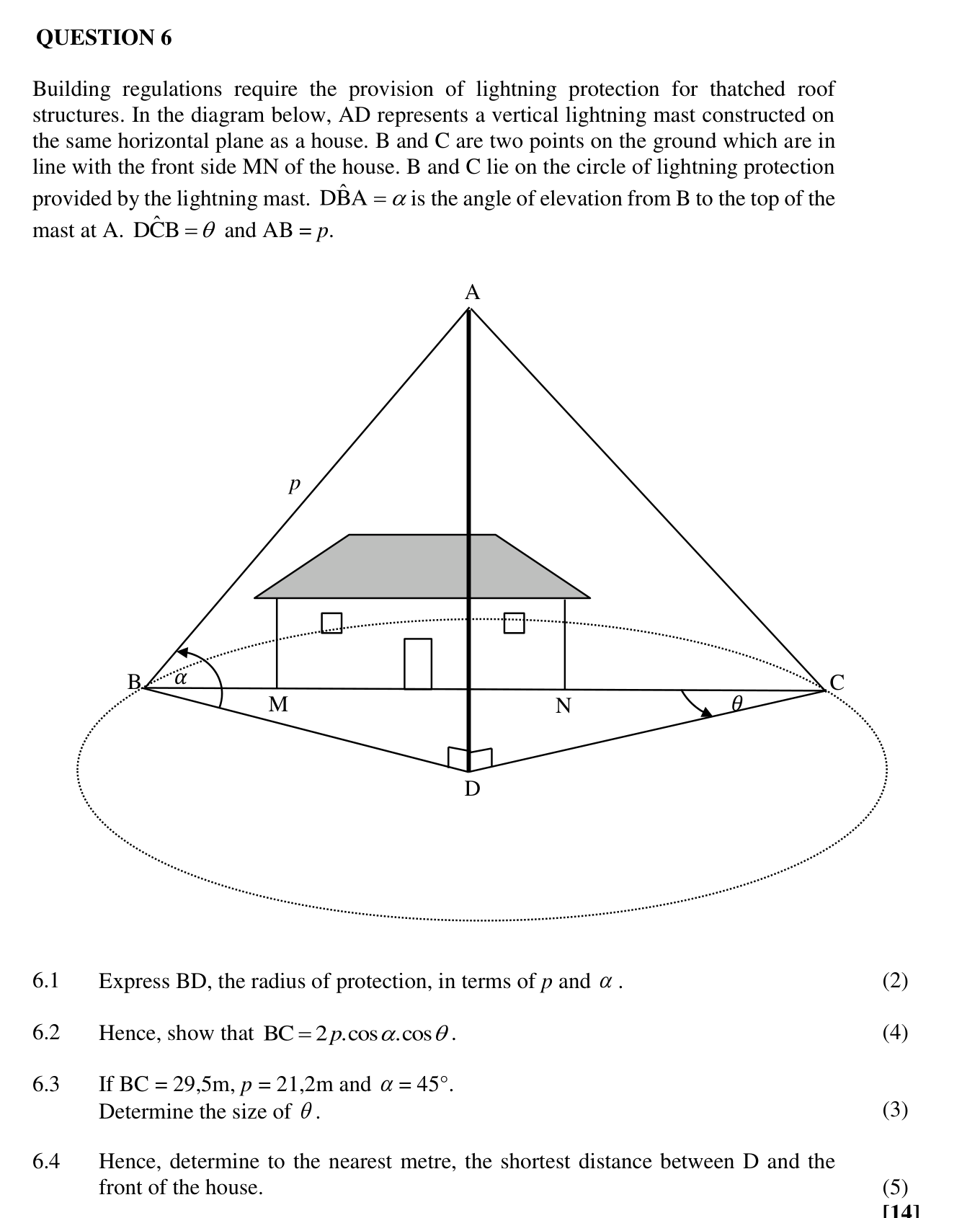
Northern Cape September 2022 Question 6: a vertical lightning mast AD standing over a house, with points B and C on the ground where the mast's protection circle meets the line through the house's front side
The original exam diagram: \(AD\) is the vertical mast, \(B\) and \(C\) are ground points on the lightning-protection circle centred at \(D\) — since \(BD\) and \(DC\) are both radii of that circle, \(\triangle BDC\) is isosceles.

A vertical lightning mast \(AD\) stands over a house; \(B\) and \(C\) are ground points on the mast's circle of protection (centred at \(D\), the foot of the mast). \(\angle DBA=\alpha\) is the angle of elevation from \(B\) to the top of the mast, and \(AB=p\). Since \(BD=DC\) (both radii), \(\angle DBC=\angle DCB=\theta\). Show \(BD=p\cos\alpha\), then \(BC=2p\cos\alpha\cos\theta\); given \(BC=29{,}5\) m, \(p=21{,}2\) m and \(\alpha=45°\), find \(\theta\) and, to the nearest metre, the shortest distance from \(D\) to \(BC\).

Show memo-verified solution
  1. 1Right triangle: \(\dfrac{BD}{p}=\cos\alpha\Rightarrow BD=p\cos\alpha\)
  2. 2In \(\triangle BCD\): \(\angle BDC=180°-2\theta\). Sine rule: \(\dfrac{BC}{\sin(180°-2\theta)}=\dfrac{BD}{\sin\theta}\Rightarrow BC=\dfrac{p\cos\alpha\cdot2\sin\theta\cos\theta}{\sin\theta}=2p\cos\alpha\cos\theta\)
  3. 3\(29{,}5=2(21{,}2)\cos45°\cos\theta\Rightarrow\theta\approx10{,}3°\)
  4. 4Perpendicular \(DE\) bisects \(BC\): \(BE=\tfrac12BC=14{,}75\text{ m}\), while \(BD=21{,}2\cos45°\). Keep the full calculator value for \(BD\).
  5. 5Pythagoras: \(DE=\sqrt{(21{,}2\cos45°)^2-(14{,}75)^2}\approx2{,}68\text{ m}\). Therefore, to the nearest metre, \(\boxed{DE=3\text{ m}}\).
Quick Check

All three sides of a triangle are known, no angles. Which rule finds an angle?

In \(\triangle ABC\), \(AB=7\), \(BC=10\), \(\hat B=65°\). Find \(AC\) (2 d.p.).

2D & 3D Applications

A big diagram is just a chain of ordinary triangles.

The application habit that earns marks

“Name the triangle. Name the rule. Carry the answer to the next triangle.”

Step 1

Mark every right angle and every straight line — that's how the picture splits.

Step 2

Solve the triangle with the most information first.

Step 3

A shared side (e.g. \(AC\), \(LN\)) bridges one triangle to the next.

Step 4

Do the final target (height, area, angle) last, not first.

Worked example — a single right triangle Level 1

A vertical flagpole \(AB\) stands on level ground. From a point \(C\) on the ground, \(20\) m from the base \(B\), the angle of elevation to the top \(A\) is \(35°\). Determine the height \(AB\), correct to one decimal place.

Show solution
  1. 1\(\triangle ABC\) is right-angled at \(B\): \(\tan35°=\dfrac{AB}{20}\)
  2. 2\(AB=20\tan35°\)
  3. 3\(\boxed{AB\approx14{,}0\text{ m}}\)
Paper-derived example — KZN SCTHS Term 1 Test 5 (2026), Q3.1 (7 marks) Level 3-4

\(KN\) is a vertical tower of height \(h\) on plane \(LMN\). Angle of elevation of \(K\) from \(L\) is \(w\); \(\angle NLM=y\), \(\angle NML=z\). Show \(LN=\dfrac{h}{\tan w}\), hence \(LM=\dfrac{h\sin(y+z)}{\tan w\sin z}\); calculate \(LM\) for \(h=38\) m, \(w=21°\), \(y=52°\), \(z=59°\).
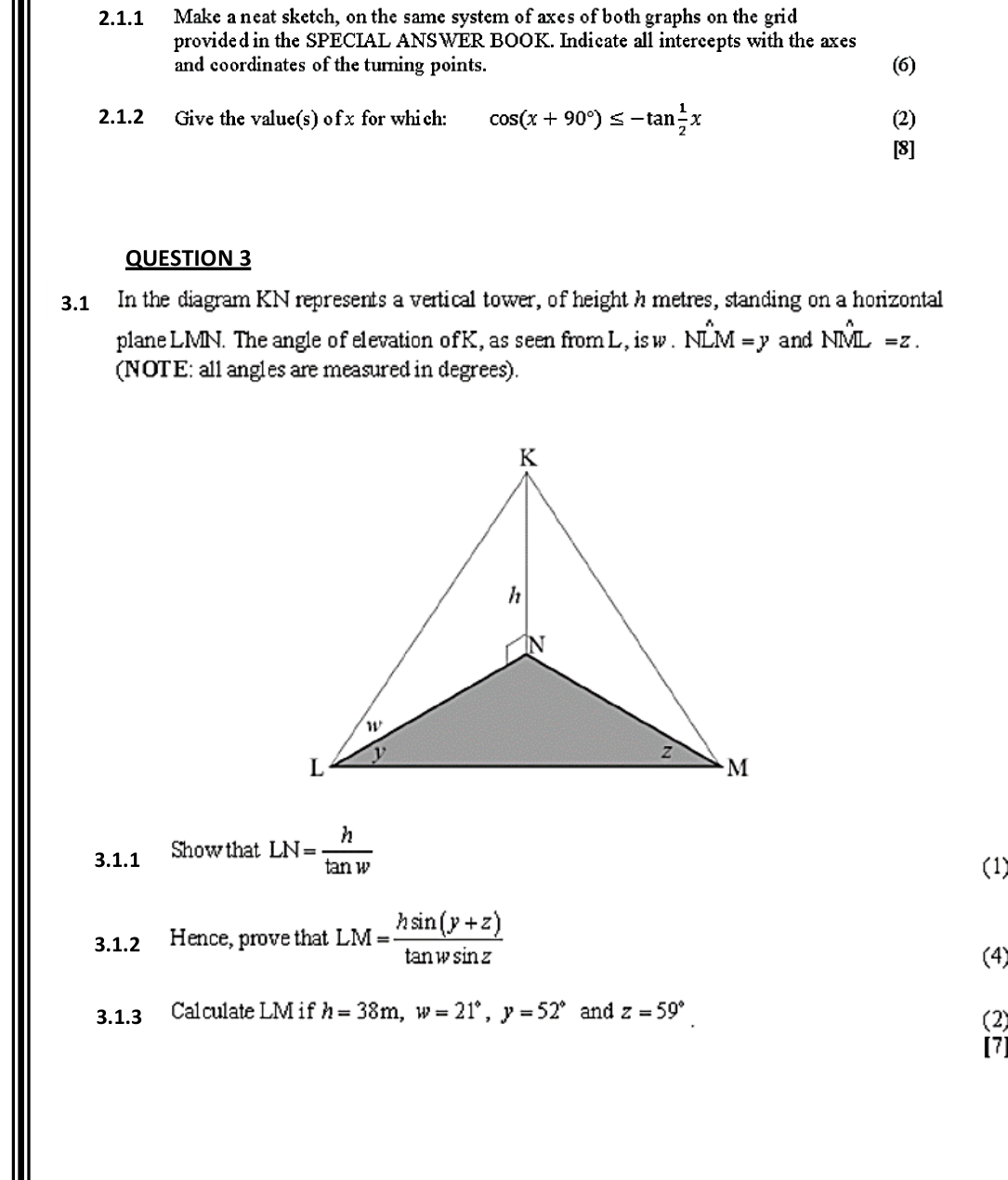
KZN 2026 Question 3 showing a vertical tower KN above horizontal plane LMN, with height h, angle of elevation w, and ground angles y and z.
Original KZN SCTHS test diagram: right triangle \(\triangle KLN\) gives \(LN\); ground triangle \(\triangle LMN\) then gives \(LM\) via the sine rule.

Source status: the question and diagram were checked against the supplied paper; the solution was independently verified because no marking guideline was supplied.

Show solution
  1. 1In \(\triangle KLN\) (right-angled at \(N\)): \(\tan w=\dfrac{h}{LN}\Rightarrow LN=\dfrac{h}{\tan w}\)
  2. 2In \(\triangle LMN\), third angle \(\angle LNM=180°-y-z\). Sine rule: \(\dfrac{LN}{\sin z}=\dfrac{LM}{\sin(180°-y-z)}\)
  3. 3Since \(\sin(180°-y-z)=\sin(y+z)\): \(LM=\dfrac{LN\sin(y+z)}{\sin z}=\dfrac{h\sin(y+z)}{\tan w\sin z}\)
  4. 4Substitute: \(LM=\dfrac{38\sin111°}{\tan21°\sin59°}\approx\boxed{107{,}8\text{ m}}\)
Quick Check

In a 2D problem you're given two angles and one side (AAS). Which rule finds a missing side?

Vertical pole PQ stands at corner P of horizontal rectangle PQRS. Elevation of Q from R is 35°, PR=18m. Find PQ.

Exam Strategy & Final Memory Map

The eight formulas everything else is built from.

Common errorFix
Dividing by a trig functionFactorise instead — division can delete a whole solution family.
Only one solution family for sin/cosBoth need two families; only tan needs one.
Switching ratio name in the 180°/360° familyOnly the 90°/270° family switches names.
\(\sin2x=2\sin x\)It's \(2\sin x\cos x\) — the 2 multiplies the product.
Core formulas to know
\[\sin^2\theta+\cos^2\theta=1\qquad\cos(\alpha-\beta)=\cos\alpha\cos\beta+\sin\alpha\sin\beta\]\[\sin2\alpha=2\sin\alpha\cos\alpha\qquad\cos2\alpha=2\cos^2\alpha-1\]\[\frac{a}{\sin A}=\frac{b}{\sin B}=\frac{c}{\sin C}\qquad a^2=b^2+c^2-2bc\cos A\qquad\text{Area}=\frac12ab\sin C\]
Exam mantra
Draw first. Reduce second. Substitute third. Sketch CAST before manipulating algebra, and sign errors drop dramatically.
1 / 30

What CAPS Expects You to Know

The Grade 12 Trigonometry knowledge statement this page is built from.

  1. 1

    Derive and use the sine, cosine and tangent compound-angle identities.

  2. 2

    Accept \(\sin2\alpha=2\sin\alpha\cos\alpha\), then derive and use all three forms of \(\cos2\alpha\).

  3. 3

    Apply compound and double-angle identities to prove identities and solve trigonometric equations without losing solutions through division.

  4. 4

    Revise the proofs of the sine, cosine and area rules before applying them.

  5. 5

    Solve linked problems in two and three dimensions.

  • All other content on this page — the CAST diagram, special angles, reduction formulae, general solutions, trig graphs, and the sine/cosine/area rules — is revision from Grade 10 and 11, examined cumulatively alongside the new Grade 12 material.

How to Use This Lesson

A few practical notes before you start.

  • If the CAST diagram or reduction formulae feel shaky, revisit the Grade 10 and Grade 11 pages first — everything here assumes that foundation is solid.
  • Both the compound angle and double angle identities are explicitly examinable to prove, not just apply — know the derivations, not only the formulas.
  • In equations, never divide by a trig expression — always factorise.
  • Try each worked example yourself before pressing “Show solution.”

Learn It in Short Videos

Four free, independent videos — not made by Equation Station SA.

Compound Angles

Where the sine and cosine addition formulas come from.

Khan Academy · Proof of angle addition formula for sine

Double Angles

Applying the double angle identities to simplify and solve.

Khan Academy · Double angle formula for cosine example

Proving Identities

Using the Pythagorean identity to simplify a trig expression — the core move behind most identity proofs.

Khan Academy · Examples using Pythagorean identities

Triangle Rules & Applications

Solving non-right triangles with the sine rule.

Khan Academy · Law of sines

Learn More by Subtopic

Choose the skill holding you back, work through another explanation, then return to an exam-style question.

These links open other websites in a new tab. Use Siyavula for the South African grade sequence and the DBE archive for official exam practice. International lessons may include radians or extra topics; follow the degree intervals in your question.

Ready to practise? Return to the Grade 12 Mastery Bank.

Common Exam Mistakes

Avoid these errors. They cost marks every year.

Dividing by a trig function in an equation

Always factorise instead — dividing silently deletes an entire solution family.

Reversing the cos compound-angle sign

\(\cos(A-B)\) adds; \(\cos(A+B)\) subtracts — the reverse of the sin pattern.

Writing \(\sin2x=2\sin x\)

It's \(2\sin x\cos x\) — the 2 multiplies the product, not just \(\sin x\).

Crossing the equals sign in a proof

Work on one side only — cross-multiplying assumes what you're trying to prove.

Skipping the ambiguous-case check (SSA)

Always test both \(\theta\) and \(180°-\theta\) when the given angle is acute.

Practise This Topic

You've done the notes above — now practise and test yourself.

BANK
Mastery Bank
Grade 12 Trigonometry Mastery Bank

Exam-style Grade 12 questions arranged by level, combining original practice with clearly identified paper-and-memo matches.

Step 1 • Practise • Cognitive Levels
Open Mastery Bank
TEST
Test Your Knowledge
Trigonometry Grade 12 Test Your Knowledge

Auto-marked quiz with instant feedback, explanations and a complete answer review.

Step 2 • Test Yourself • Auto-Marked + Review
Test Your Knowledge

Frequently Asked Questions

Straight answers to common Grade 12 CAPS questions about trigonometry.

What is new in Grade 12 Trigonometry?

Grade 12 adds compound angle identities, double angle identities, proving identities from first principles, and extends problem-solving from 2D into 3D using the sine, cosine and area rules from Grade 11.

Are the compound and double angle proofs examinable?

Yes. CAPS explicitly lists proof and use of the compound angle and double angle identities as examinable content.

How do I prove a trig identity?

Work on one side only, usually the more complex side, convert everything to sine and cosine if you get stuck, and look for opportunities to use the Pythagorean, compound angle or double angle identities. Never cross-multiply or move terms across the equals sign.

Why can't I divide both sides of a trig equation by sin x or cos x?

Dividing can silently delete an entire solution family (wherever that ratio equals zero). Always move everything to one side and factorise instead.

Which resource should I open first for this topic?

Everything you need to learn the topic is on this page already. Once you've been through the notes above, work through the Mastery Bank, then finish with the Test Your Knowledge quiz as a self-check.