Home Topics Trigonometry (Grade 10)

Trigonometry — Grade 10

Why similar triangles make the ratios work, SOH-CAH-TOA, special angles you can derive without a calculator, extending ratios to any angle with the Cartesian plane, CAST and reference angles, reciprocal ratios, and solving real 2D problems. Notes, a mastery bank and a quiz — everything for this topic is one click away.
CAPS alignedGrade 10Paper 2Interactive notes
Guided Course Slides
Quick checks: 0/0
Grade 10 CAPS Mathematics

Trigonometry

From right triangles to the Cartesian plane: SOH-CAH-TOA, why the ratios work, special angles, CAST and reference angles, reciprocal ratios, and 2D applications.

What Is Trigonometry?

The relationship between a triangle's angles and its side lengths.

The big idea

Trigonometry studies the relationship between the angles and the side lengths of a triangle.

Where we're headed

This module builds the idea from scratch: right triangles → ratios → special angles → the full 0°–360° plane → real applications. Each slide only needs what came before it.

Similar Triangles — Why the Ratios Work

The reason sin, cos and tan depend only on the angle, never on size.

Two right triangles with the same angle theta but different sizes A small right triangle and a larger right triangle, both with the same 40-degree angle at the bottom left, showing that the ratio of opposite to hypotenuse is the same in both despite the different sizes. θ small θ large (1.7× bigger)
Same angle, same shape: the large triangle is just the small one scaled up by a factor of 1.7 — every side is 1.7× longer. But the RATIO \(\dfrac{\text{opposite}}{\text{hypotenuse}}\) is identical in both, because scaling multiplies both the numerator and denominator by the same factor, which cancels out.
Why this matters
Two right triangles that share an acute angle are always similar (same shape, possibly different size), because their three angles match (the shared acute angle, the right angle, and \(180°\) minus both). Similar triangles have sides in constant proportion, so \(\sin\theta\), \(\cos\theta\) and \(\tan\theta\) are genuine functions of the angle alone — the whole reason a single special-angle table can work for every right triangle with that angle, no matter its size.

Right Triangles — Naming the Sides

Before any ratios: what do we call each side?

The same right triangle labelled from two different angles, showing opposite and adjacent swap Left panel: a right triangle with the angle marked at the bottom-left vertex, showing the bottom side as adjacent and the right side as opposite. Right panel: the identical triangle shape with the angle marked at the top vertex instead, showing the same two sides with their labels swapped. θ adjacent opposite hypotenuse angle marked bottom-left θ opposite adjacent hypotenuse same triangle, angle marked top
The one label that never moves: the hypotenuse is always the side opposite the right angle — the longest side, fixed no matter which acute angle you pick. "Opposite" and "adjacent" are only fixed once you've chosen an angle — pick the other acute angle in the same triangle and they swap, exactly as shown above.
Rule of thumb
Find the right angle first (it never changes). Then find the hypotenuse (opposite the right angle). Then, relative to whichever angle you're using, the side touching that angle (that isn't the hypotenuse) is adjacent, and the side that doesn't touch it is opposite.

Defining sin, cos and tan

Three ratios, three pairs of sides.

A right-angled triangle with the angle theta, hypotenuse, opposite and adjacent sides labelled A right triangle with the right angle at the bottom right, angle theta at the bottom left, the side from theta to the right angle labelled adjacent, the vertical side labelled opposite, and the slanted side labelled hypotenuse. θ adjacent opposite hypotenuse
Reading the diagram: "opposite" and "adjacent" are always relative to the angle \(\theta\) you're working with — the hypotenuse never changes, but if you looked at the OTHER acute angle, opposite and adjacent would swap.
The three ratios
\[\sin\theta=\dfrac{\text{opposite}}{\text{hypotenuse}}\quad\cos\theta=\dfrac{\text{adjacent}}{\text{hypotenuse}}\quad\tan\theta=\dfrac{\text{opposite}}{\text{adjacent}}\]
SOH-CAH-TOA

Sin = Opp/Hyp,  Cos = Adj/Hyp,  Tan = Opp/Adj — the classic memory aid.

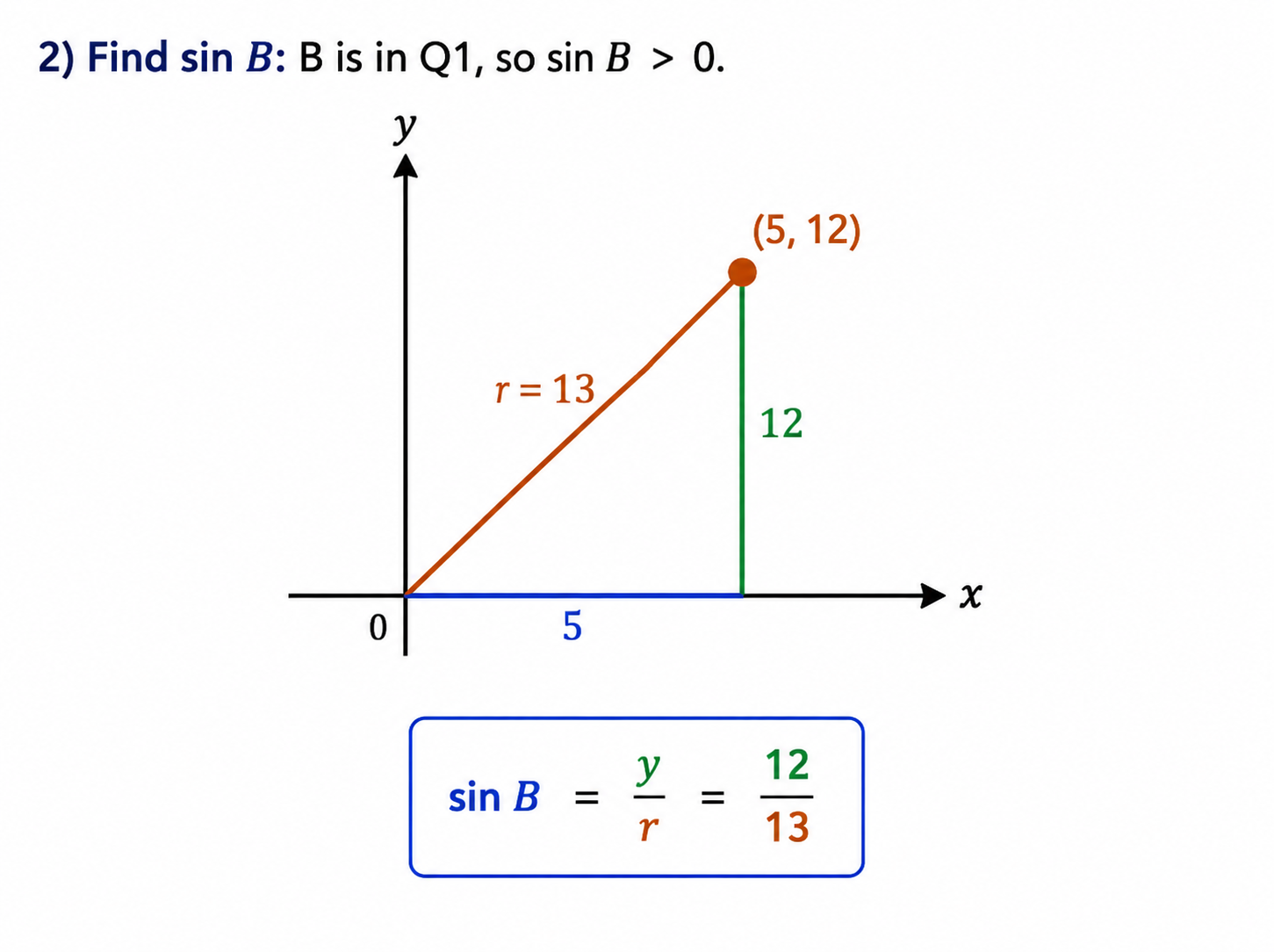
A coordinate right triangle in Quadrant 1 with point (5, 12), horizontal side 5, vertical side 12, hypotenuse 13, and sin B equal to 12 over 13.
Read the sides from the picture first: for angle \(B\), the vertical side is the opposite side and \(r=13\) is the hypotenuse.
Worked example Level 1-2

Use the diagram. Point \(B\) is in Quadrant 1. Determine \(\sin B\).

Show solution
  1. 1Check the triangle: \(5^2+12^2=25+144=169=13^2\).
  2. 2For sine, use opposite over hypotenuse: \(\sin B=\dfrac{y}{r}\).
  3. 3\(\sin B=\dfrac{12}{13}\). It is positive because the terminal arm is in Quadrant 1.
Quick Check

Two right triangles share the same acute angle \(\theta\). What does this guarantee?

In a right triangle, if opposite = 5, adjacent = 12, hypotenuse = 13, what is \(\cos\theta\)?

Finding a Missing Side

Given one angle and one side, find another side.

A right triangle with angle 35 degrees, hypotenuse 12, and the opposite side unknown A right triangle with angle 35 degrees at the bottom left, hypotenuse 12 as the slanted side, adjacent side along the bottom, and the opposite side on the right marked as the unknown x to be found. 35° adjacent x 12
The angle and the hypotenuse are known; the opposite side \(x\) is unknown.
Worked example Level 1

In a right triangle, \(\theta=35°\) and the hypotenuse is 12. Find the length of the side opposite \(\theta\), correct to one decimal place.

Show solution
  1. 1Opposite and hypotenuse are involved, so use sine: \(\sin\theta=\dfrac{\text{opp}}{\text{hyp}}\)
  2. 2\(\sin35°=\dfrac{x}{12}\)
  3. 3\(x=12\sin35°\)
  4. 4\(x\approx12\times0{,}5736\approx\boxed{6{,}9}\)
Worked example — using cosine Level 2

In a right triangle, \(\theta=40°\) and the hypotenuse is 15. Find the length of the side adjacent to \(\theta\), correct to one decimal place.

Show solution
  1. 1Adjacent and hypotenuse are involved, so use cosine: \(\cos\theta=\dfrac{\text{adj}}{\text{hyp}}\)
  2. 2\(\cos40°=\dfrac{x}{15}\)
  3. 3\(x=15\cos40°\)
  4. 4\(x\approx15\times0{,}7660\approx\boxed{11{,}5}\)
Method
Always identify which TWO sides are involved (one known, one unknown) relative to the known angle, choose the ratio that uses exactly those two sides, then rearrange to make the unknown the subject.

Finding a Missing Angle

Given two sides, use the inverse ratio to find the angle.

A right triangle with opposite 7, adjacent 9, and the angle theta unknown A right triangle with an unknown angle theta at the bottom left, adjacent side 9 along the bottom, and opposite side 7 on the right. θ 9 7
Both legs are known; the angle \(\theta\) itself is unknown.
Worked example Level 1

In a right triangle, the side opposite \(\theta\) is 7 and the side adjacent to \(\theta\) is 9. Find \(\theta\), correct to one decimal place.

Show solution
  1. 1Opposite and adjacent are involved, so use tangent: \(\tan\theta=\dfrac{\text{opp}}{\text{adj}}=\dfrac{7}{9}\)
  2. 2To undo tan and isolate \(\theta\), use the inverse function \(\tan^{-1}\) (on a calculator: SHIFT + tan):
  3. 3\(\theta=\tan^{-1}\left(\dfrac{7}{9}\right)\)
  4. 4\(\theta\approx\boxed{37{,}9°}\)
Worked example — using sine Level 2

In a right triangle, the side opposite \(\theta\) is 5 and the hypotenuse is 13. Find \(\theta\), correct to one decimal place.

Show solution
  1. 1Opposite and hypotenuse are involved, so use sine: \(\sin\theta=\dfrac{\text{opp}}{\text{hyp}}=\dfrac{5}{13}\)
  2. 2Use the inverse function \(\sin^{-1}\): \(\theta=\sin^{-1}\left(\dfrac{5}{13}\right)\)
  3. 3\(\theta\approx\boxed{22{,}6°}\)
Common mistake
\(\tan^{-1}\) means "the angle whose tangent is..." — it does not mean \(\dfrac{1}{\tan\theta}\). That reciprocal is \(\cot\theta\), a completely different quantity.
Quick Check

A right triangle has \(\theta=50°\) and adjacent side 10. Which equation finds the hypotenuse \(h\)?

In a right triangle, opposite = 8 and adjacent = 15. Which equation finds \(\theta\)?

2D Applications

Angles of elevation and depression.

An observer looking up at a building, showing the angle of elevation A right triangle with the observer at the bottom left, a horizontal dashed line, the building on the right, and the angle of elevation marked between the horizontal and the line of sight to the top of the building. θ observer building horizontal
Definitions: the angle of elevation is measured from the horizontal up to the object; the angle of depression is measured from the horizontal down to the object. For the same line of sight, they're numerically equal (alternate angles, parallel horizontals).
Two right triangles: a surveyor sighting a building at 30 degrees elevation, and a cliff-top observer sighting a boat at 20 degrees depression Left: a right triangle with a 60m base and a 30 degree angle of elevation to the building top. Right: a right triangle with a 45m vertical cliff and a 20 degree angle of depression down to a boat. 30° 60 m height 20° 45 m d
The angle of elevation (left) and angle of depression (right) both give a right triangle — only which side is known versus unknown changes.
Worked example — elevation, decimal only Level 1

An observer stands 40 m from the base of a tree. The angle of elevation to the top is \(25°\). Find the height of the tree, correct to one decimal place.

Show solution
  1. 1\(\tan25°=\dfrac{\text{height}}{40}\)
  2. 2height \(=40\tan25°\)
  3. 3\(\boxed{\approx18{,}7\text{ m}}\)
Worked example — elevation, exact value Level 2

A surveyor stands 60 m from the base of a building. The angle of elevation to the top is \(30°\). Find the height of the building, as an exact value and correct to one decimal place.

Show solution
  1. 1\(\tan30°=\dfrac{\text{height}}{60}\)
  2. 2height \(=60\tan30°=60\cdot\dfrac{\sqrt3}{3}=20\sqrt3\)
  3. 3\(\boxed{20\sqrt3\approx34{,}6\text{ m}}\)
Worked example — depression Level 3

From the top of a 45 m cliff, the angle of depression to a boat is \(20°\). How far is the boat from the base of the cliff (to one decimal place)?

Show solution
  1. 1The angle of depression from the cliff equals the angle of elevation from the boat (alternate angles): \(20°\).
  2. 2\(\tan20°=\dfrac{45}{d} \Rightarrow d=\dfrac{45}{\tan20°}\)
  3. 3\(d\approx\dfrac{45}{0{,}364}\approx\boxed{123{,}6\text{ m}}\)
A building with a flagpole on top, seen from a point on the ground with two angles of elevation A right triangle showing a 25m building and a flagpole on top, with the angle of elevation to the top of the building at 32 degrees and to the top of the flagpole at 38 degrees, both measured from the same point on the ground. 32° 38° 25 m flag: h? observer
Two right triangles share the same base — the smaller (to the building top, \(32°\)) gives the horizontal distance; the larger (to the flag top, \(38°\)) gives the combined height.
Worked example — combined 2-triangle problem Level 4

A 25 m building has a flagpole mounted on its roof. From a point on the ground, the angle of elevation to the top of the building is \(32°\), and to the top of the flagpole is \(38°\). Find the height of the flagpole, correct to one decimal place.

Show solution
  1. 1This needs TWO triangles sharing the same horizontal distance \(d\) from the observer to the base.
  2. 2Triangle 1 (to the building top): \(\tan32°=\dfrac{25}{d} \Rightarrow d=\dfrac{25}{\tan32°}\approx40{,}0\text{ m}\)
  3. 3Triangle 2 (to the flag top): \(\tan38°=\dfrac{\text{total height}}{d} \Rightarrow \text{total height}=d\tan38°\approx40{,}0\times0{,}7813\approx31{,}3\text{ m}\)
  4. 4Flagpole height \(=\) total height \(-\) building height \(\approx31{,}3-25=\boxed{6{,}3\text{ m}}\)
Diagram decomposition
The skill examiners test most in multi-part 2D problems: split a combined figure into separate right triangles that each use ONE known angle, find what's common between them (here, the shared horizontal distance \(d\)), then combine the results. This is exactly the reasoning Grade 11 and 12 extend into full 2D and 3D problems.
Quick Check

The angle of elevation and the angle of depression for the same line of sight are:

Standing 40 m from a flagpole, the angle of elevation to the top is 45°. What is the height of the flagpole?

Special Angles — No Calculator Needed

Derived from two simple triangles, not memorised as a table.
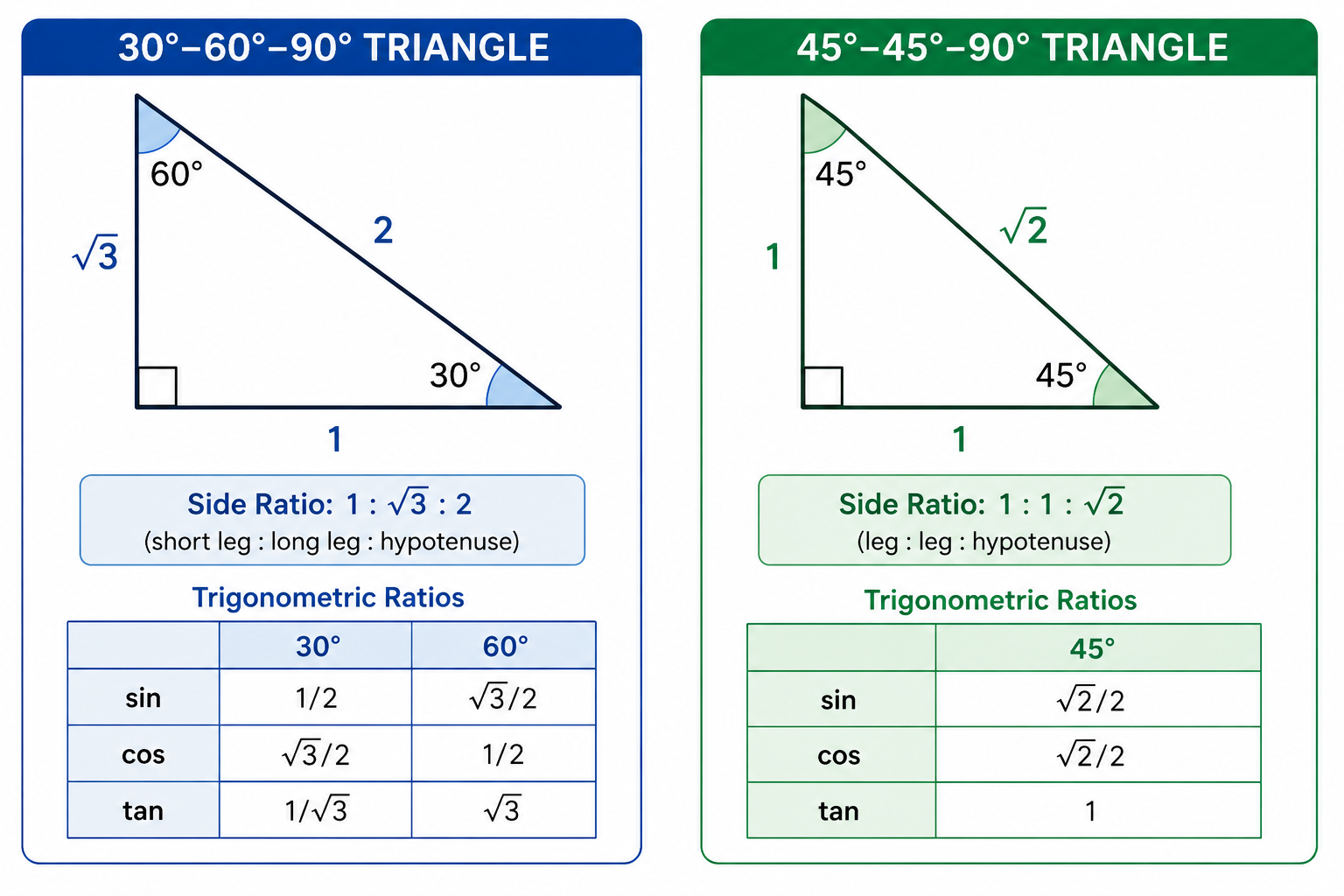
A 30-60-90 triangle with side ratio 1 to root 3 to 2 beside a 45-45-90 triangle with side ratio 1 to 1 to root 2, including the special-angle trigonometric ratios.
Where the ratios come from: in the 30-60-90 triangle (sides \(1:\sqrt3:2\)) and the 45-45-90 triangle (sides \(1:1:\sqrt2\)), every special-angle ratio is just SOH-CAH-TOA applied to these two shapes.
\(0°\)\(30°\)\(45°\)\(60°\)\(90°\)
\(\sin\)\(0\)\(\tfrac12\)\(\tfrac{\sqrt2}{2}\)\(\tfrac{\sqrt3}{2}\)\(1\)
\(\cos\)\(1\)\(\tfrac{\sqrt3}{2}\)\(\tfrac{\sqrt2}{2}\)\(\tfrac12\)\(0\)
\(\tan\)\(0\)\(\tfrac{\sqrt3}{3}\)\(1\)\(\sqrt3\)undefined
Worked example — substitute one value at a time Level 1

Evaluate, without a calculator: \(2\sin30°+\tan45°\)

Show solution
  1. 1Substitute the exact values from the special-angle table: \(\sin30°=\dfrac12\) and \(\tan45°=1\)
  2. 2\(2\left(\dfrac12\right)+1=1+1\)
  3. 3\(\boxed{2}\)
Worked example — combine two ratios Level 2

Evaluate, without a calculator: \(\sin60°\cdot\cos30°+\cos60°\cdot\sin30°\)

Show solution
  1. 1Substitute exact values: \(\dfrac{\sqrt3}{2}\cdot\dfrac{\sqrt3}{2}+\dfrac12\cdot\dfrac12\)
  2. 2\(=\dfrac{3}{4}+\dfrac14=\boxed{1}\)
Quick Check

What is \(\cos45°\)?

Solve for \(\theta\) (\(0°\leq\theta\leq90°\)): \(\cos\theta=\dfrac{\sqrt3}{2}\)

Beyond 90°: The Cartesian Plane

Right triangles only go up to 90°. Here's how the ratios extend further.
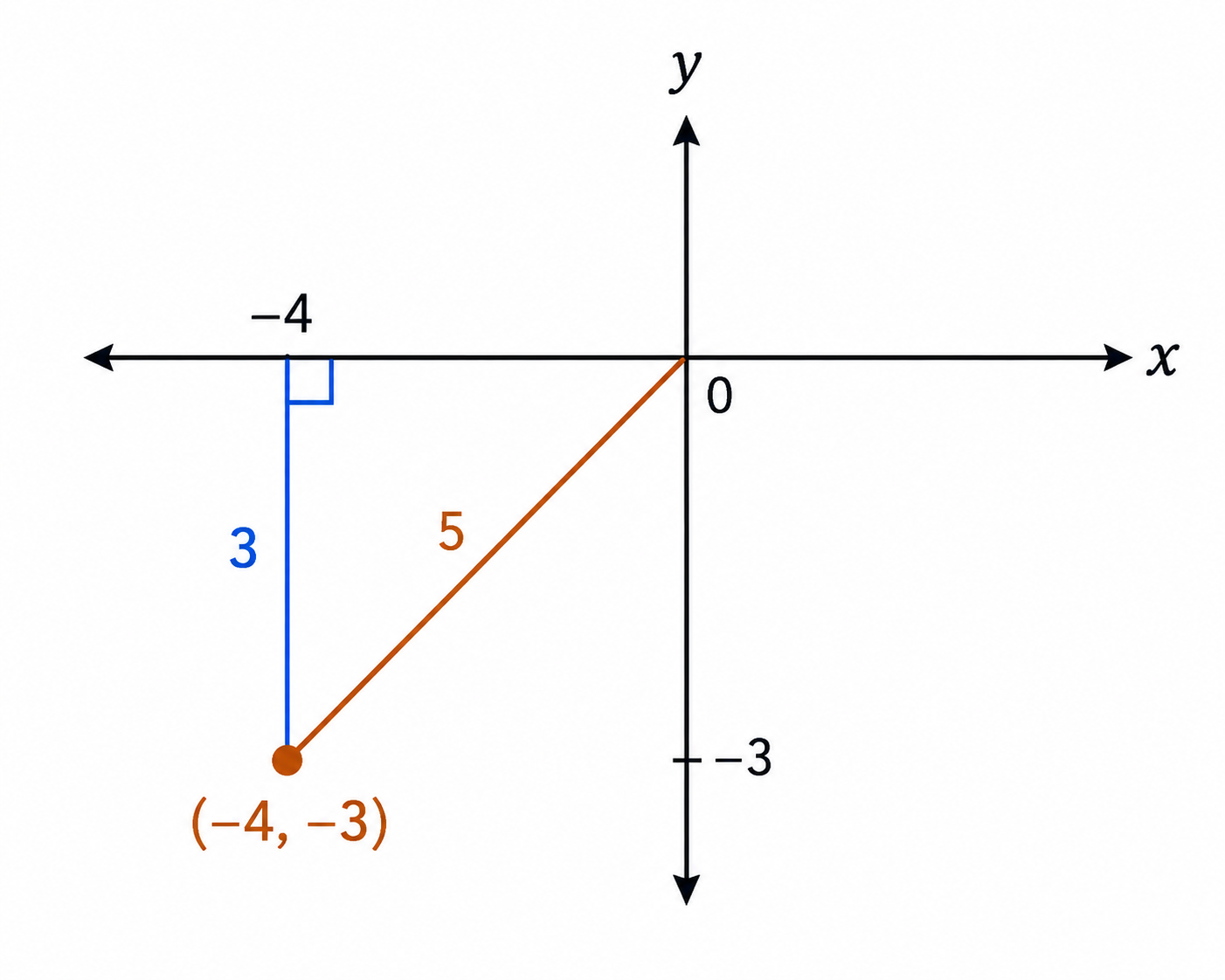
A coordinate triangle in Quadrant 3 with point negative 1, negative 2, horizontal coordinate negative 1, vertical coordinate negative 2, and radius root 5.
Reading the diagram: for ANY point \((x,y)\) on the terminal arm of angle \(\theta\), with \(r=\sqrt{x^2+y^2}\) always taken as positive, the ratios are redefined so they work for any angle from \(0°\) to \(360°\).
The extended definitions
\[\sin\theta=\dfrac{y}{r}\qquad\cos\theta=\dfrac{x}{r}\qquad\tan\theta=\dfrac{y}{x}\]

This matches SOH-CAH-TOA exactly when \(\theta\) is between \(0°\) and \(90°\) — it just also works when \(x\) or \(y\) is negative.
Angles From 0° to 360°

Standard position: every angle is a rotation from the positive x-axis.

Two angles in standard position, 120 degrees and 250 degrees, measured counter-clockwise from the positive x-axis A circle centred at the origin with two terminal arms drawn: one rotated 120 degrees counter-clockwise from the positive x-axis into Quadrant 2, and one rotated 250 degrees counter-clockwise through Quadrants 1, 2 and 3, each with an arc showing the rotation amount. 120° 250° 0°/360° 90° 180° 270°
Standard position: the initial arm always sits on the positive x-axis; a positive angle is measured by rotating counter-clockwise to the terminal arm. \(120°\) lands in Quadrant 2, \(250°\) lands in Quadrant 3 — the quadrant the terminal arm lands in is what the CAST diagram is about.
Read the full rotation
A positive \(250°\) turn goes counter-clockwise past \(90°\) and \(180°\), then stops in Quadrant 3. The short clockwise gap from the positive x-axis to the same terminal arm is \(110°\), but that is not the positive angle \(250°\).

The CAST Diagram

Which ratios are positive in which quadrant.

The CAST diagram showing which ratio is positive in each quadrant A set of axes dividing the plane into 4 quadrants, labelled A (all positive) top right, S (sin positive) top left, T (tan positive) bottom left, C (cos positive) bottom right. A all + S sin + T tan + C cos + 0°/360° 90° 180° 270°
Reading "CAST": starting bottom-right and going counter-clockwise — C(Q4), A(Q1), S(Q2), T(Q3) — spells CAST. In every quadrant, exactly one ratio (or all three) is positive; the other(s) are negative.
Why this matters
\(r\) is always positive (it's a distance), but \(x\) and \(y\) can be negative depending on the quadrant — that's the only reason a ratio's sign ever changes.
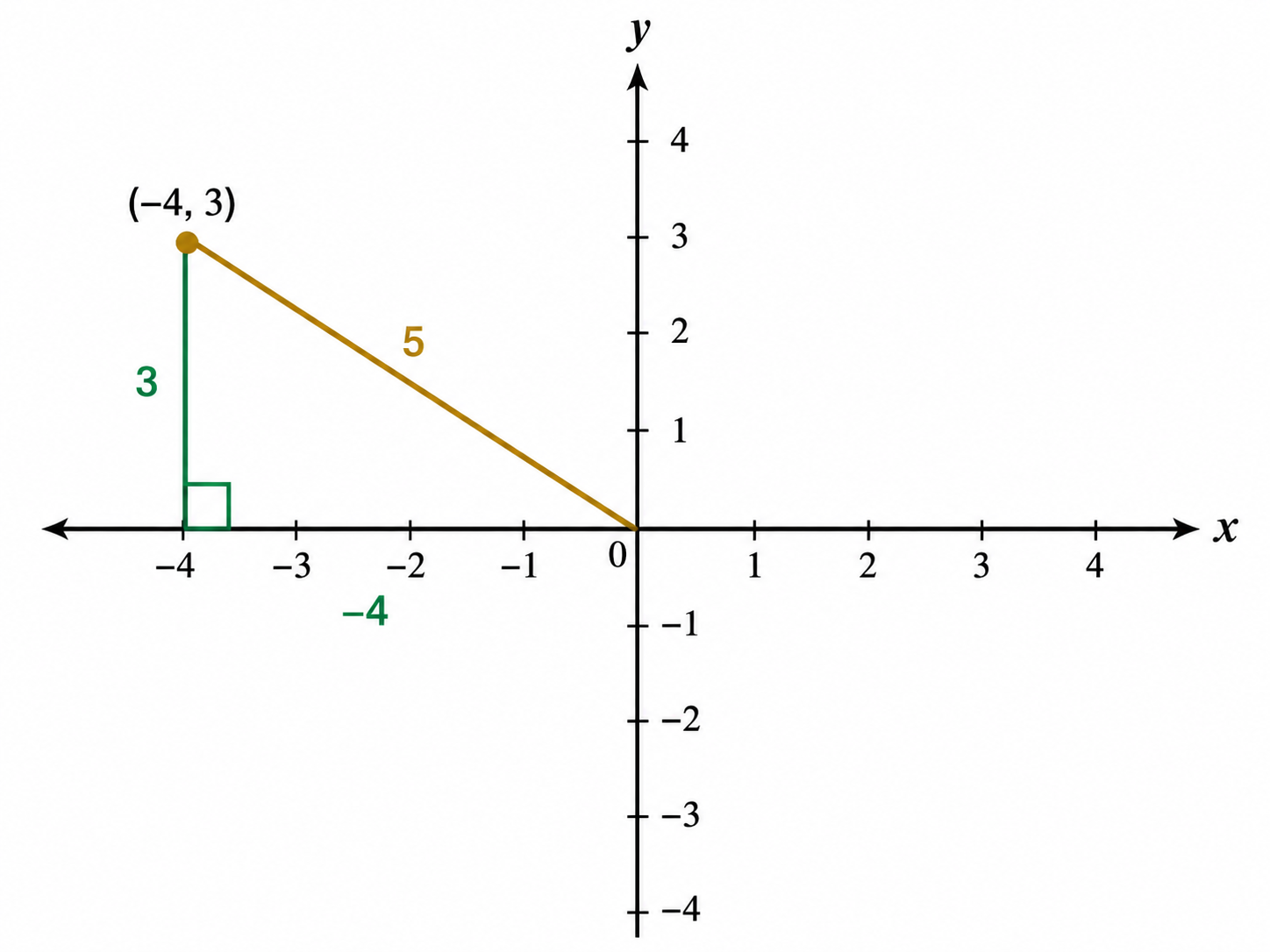
A coordinate triangle in Quadrant 2 with point negative 4, 3, vertical side 3, horizontal side negative 4, and radius 5.
\(\sin\theta=\dfrac35>0\) and \(\theta\) obtuse places the point in Quadrant 2, where \(x<0\) but \(y\) and \(r\) stay positive.
Worked example — Quadrant 1, everything positive Level 1

Given \(\sin\theta=\dfrac45\) and \(\theta\) is acute (\(0°<\theta<90°\)), determine \(\cos\theta\) and \(\tan\theta\).

Show solution
  1. 1Acute means Quadrant 1, so \(x>0\), \(y>0\), \(r>0\) — no signs to track. Take \(y=4\), \(r=5\) (matching the 3-4-5 triangle).
  2. 2Find \(x\): \(x^2+y^2=r^2\Rightarrow x^2=25-16=9\Rightarrow x=3\) (positive in Q1).
  3. 3\(\cos\theta=\dfrac{x}{r}=\dfrac{3}{5}=\boxed{0{,}6}\)
  4. 4\(\tan\theta=\dfrac{y}{x}=\dfrac{4}{3}=\boxed{1{,}33}\)
Worked example Level 2

Given \(\sin\theta=\dfrac35\) and \(\theta\) is obtuse (\(90°<\theta<180°\)), determine \(\cos\theta\) and \(\tan\theta\).

Show solution
  1. 1Obtuse means Quadrant 2, so \(y>0\), \(x<0\), \(r>0\). Take \(y=3\), \(r=5\) (matching the 3-4-5 triangle).
  2. 2Find \(x\): \(x^2+y^2=r^2 \Rightarrow x^2=25-9=16 \Rightarrow x=\pm4\). Since \(x<0\) in Q2, \(x=-4\).
  3. 3\(\cos\theta=\dfrac{x}{r}=\dfrac{-4}{5}=\boxed{-0{,}8}\)
  4. 4\(\tan\theta=\dfrac{y}{x}=\dfrac{3}{-4}=\boxed{-0{,}75}\)
Worked example — a different quadrant Level 3-4

Given \(\cos\theta=-\dfrac{5}{13}\) and \(\theta\) is reflex (\(180°<\theta<270°\)), determine \(\sin\theta\) and \(\tan\theta\).

Show solution
  1. 1\(180°<\theta<270°\) is Quadrant 3, where \(x<0\), \(y<0\), \(r>0\). Take \(x=-5\), \(r=13\) (matching the 5-12-13 triangle).
  2. 2Find \(y\): \(x^2+y^2=r^2\Rightarrow y^2=169-25=144\Rightarrow y=\pm12\). Since \(y<0\) in Q3, \(y=-12\).
  3. 3\(\sin\theta=\dfrac{y}{r}=\dfrac{-12}{13}=\boxed{-\dfrac{12}{13}}\)
  4. 4\(\tan\theta=\dfrac{y}{x}=\dfrac{-12}{-5}=\boxed{\dfrac{12}{5}}\) (positive, since both \(y\) and \(x\) are negative in Q3)
Quick Check

In which quadrant is \(\tan\theta\) the only positive ratio?

If \(\theta\) is in Quadrant 4, which ratio is positive?

Reference Angles

The bridge between CAST and the special-angle table.

Two angles, 150 degrees and 210 degrees, each with their reference angle of 30 degrees marked against the x-axis A circle with a terminal arm at 150 degrees in Quadrant 2 and one at 210 degrees in Quadrant 3, each with a small arc showing the acute 30 degree gap between the arm and the nearest part of the x-axis. 150° 30° 210° 30°
The reference angle is the acute angle (always between \(0°\) and \(90°\)) between the terminal arm and the x-axis — not the origin's angle itself. Both \(150°\) and \(210°\) have a reference angle of \(30°\), since each arm sits exactly \(30°\) from the nearest part of the x-axis.
Finding the reference angle from \(\theta\)
\[\text{Q2: } 180°-\theta \qquad \text{Q3: } \theta-180° \qquad \text{Q4: } 360°-\theta\]
Worked example Level 3

Evaluate \(\sin150°\) without a calculator.

Show solution
  1. 1\(150°\) is in Quadrant 2, so the reference angle is \(180°-150°=30°\).
  2. 2The reference angle gives the SIZE: \(\sin30°=\dfrac12\) (from the special-angle table).
  3. 3CAST gives the SIGN: Quadrant 2 is the "S" quadrant, so sine is positive.
  4. 4\(\sin150°=\boxed{+\dfrac12}\)
Two-step method
To evaluate any ratio beyond \(90°\) without a calculator: (1) find the reference angle to get the SIZE from the special-angle table, (2) use CAST to get the SIGN. This is exactly the technique Grade 11 builds on with the formal reduction formulae.
Quick Check

What is the reference angle of \(300°\)?

Using the reference angle and CAST, what is \(\cos210°\)?

Reciprocal Ratios

Three more ratios — each one flips a fraction from before.

Definitions
\[\csc\theta=\dfrac{1}{\sin\theta}=\dfrac{\text{hyp}}{\text{opp}}\qquad\sec\theta=\dfrac{1}{\cos\theta}=\dfrac{\text{hyp}}{\text{adj}}\qquad\cot\theta=\dfrac{1}{\tan\theta}=\dfrac{\text{adj}}{\text{opp}}\]
Common mistake
\(\csc\theta\) is the reciprocal of \(\sin\theta\), not \(\cos\theta\) — the "co-" in cosecant refers to it being paired with sine, which trips learners up. Match by the ratio you already know: sin↔csc, cos↔sec, tan↔cot.
Worked example Level 1-2

Using the diagram from the sine example (opposite \(12\), adjacent \(5\), hypotenuse \(13\)), determine \(\csc B\), \(\sec B\) and \(\cot B\).

Show solution
  1. 1\(\csc B=\dfrac{\text{hyp}}{\text{opp}}=\dfrac{13}{12}\)
  2. 2\(\sec B=\dfrac{\text{hyp}}{\text{adj}}=\dfrac{13}{5}\)
  3. 3\(\cot B=\dfrac{\text{adj}}{\text{opp}}=\dfrac{5}{12}\)
Worked example — starting from just one ratio Level 2

If \(\tan\theta=\dfrac34\) and \(\theta\) is acute, determine \(\sin\theta\), \(\cos\theta\) and \(\sec\theta\).

Show solution
  1. 1\(\tan\theta=\dfrac{\text{opp}}{\text{adj}}=\dfrac34\), so sketch a right triangle with opposite \(3\) and adjacent \(4\).
  2. 2Find the hypotenuse with Pythagoras: \(\sqrt{3^2+4^2}=\sqrt{25}=5\)
  3. 3\(\sin\theta=\dfrac{\text{opp}}{\text{hyp}}=\dfrac35\) and \(\cos\theta=\dfrac{\text{adj}}{\text{hyp}}=\dfrac45\)
  4. 4\(\sec\theta=\dfrac{1}{\cos\theta}=\dfrac{\text{hyp}}{\text{adj}}=\boxed{\dfrac54}\)
Quick Check

\(\sec\theta\) is the reciprocal of which ratio?

If \(\tan\theta=\dfrac{3}{4}\), what is \(\cot\theta\)?

Simple Trig Equations

For angles between 0° and 90° — the full 0°–360° case is Grade 11.

A quarter circle showing the two solved angles, 30 degrees and 60 degrees A quarter circle from 0 to 90 degrees with two rays marked: one at 30 degrees (solving sin theta = 1/2) and one at 60 degrees (solving tan theta = root 3). 30° 60° 90°
Both solutions land in the first quadrant (\(0°\)–\(90°\)) — no CAST diagram needed yet, since the domain is restricted.
Solving for \(\theta\) — direct read from the table Level 1

Solve for \(\theta\) (\(0°\leq\theta\leq90°\)): \(\tan\theta=\sqrt3\)

Show solution
  1. 1From the table, \(\tan60°=\sqrt3\). So \(\boxed{\theta=60°}\)
Solving for \(\theta\) — rearrange first Level 2

Solve for \(\theta\) (\(0°\leq\theta\leq90°\)): \(2\sin\theta-1=0\)

Show solution
  1. 1\(2\sin\theta=1 \Rightarrow \sin\theta=\dfrac12\)
  2. 2From the special-angle table, \(\sin30°=\dfrac12\). So \(\boxed{\theta=30°}\)
Quick Check

Solve for \(\theta\) (\(0°\leq\theta\leq90°\)): \(\cos\theta=\dfrac{\sqrt2}{2}\)

Solve for \(\theta\) (\(0°\leq\theta\leq90°\)): \(2\cos\theta-\sqrt3=0\)

Trig Graphs: Grade 10 Core Skills

Plot the three base graphs, then read their features accurately.

The graphs of y equals sin theta and y equals cos theta from 0 to 360 degrees Two wave curves oscillating between -1 and 1 over 0 to 360 degrees, cosine starting at its maximum and sine starting at zero, both completing one full cycle. 1 −1 90° 180° 270° 360° y = sinθ y = cosθ
Every ratio you've computed this year is one point on one of these curves. \(\sin\theta\) starts at \(0\); \(\cos\theta\) starts at its maximum, \(1\) — both repeat every \(360°\) and never leave \([-1,1]\).
The graph of y equals tan theta showing a repeating curve with vertical asymptotes A curve rising steeply near vertical dashed asymptote lines at negative 90 and positive 90 degrees, crossing zero at the origin. −90° 90° y = tanθ
A different shape: \(\tan\theta\) is undefined wherever \(\cos\theta=0\) (at \(90°\) and \(270°\), the dashed lines) — the curve shoots toward them but never touches, then repeats every \(180°\) instead of \(360°\).
Grade 10 graph routine
Plot the key angles first: \(0^\circ,90^\circ,180^\circ,270^\circ,360^\circ\). Join sine and cosine smoothly; draw tangent in separate branches between its asymptotes. Every value you calculated in this topic is one point on one of these graphs.

The Effect of \(a\) and \(q\)

Grade 10 changes the height and vertical position of a trig graph.

Forms to recognise
\[y=a\sin\theta+q\qquad y=a\cos\theta+q\qquad y=a\tan\theta+q\]
ParameterWhat you see on the graphWhat you can state
\(a\)Vertical stretch or compression; reflection in the x-axis when \(a<0\).For sin/cos, amplitude \(=|a|\). For tan, the branch is steeper or flatter.
\(q\)Moves every point up (\(q>0\)) or down (\(q<0\)).Midline is \(y=q\). For sin/cos, range is \([q-|a|;q+|a|]\).
PeriodNo horizontal change has been made.Sin/cos still repeat every \(360^\circ\); tan repeats every \(180^\circ\).
Keep the grades separate
For Grade 10, practise \(a\) and \(q\). The horizontal parameters \(k\) and \(p\) are Grade 11 work. On an exam, name the feature you can see before you write an equation.

Read a Graph, Then Build Its Equation

Use maximum, minimum and the midline instead of guessing.

Worked example — amplitude and midline only Level 1

A cosine curve has a maximum of \(5\) and a minimum of \(1\). Determine its amplitude and midline.

Show solution
  1. 1Amplitude: \(\dfrac{5-1}2=\boxed{2}\)
  2. 2Midline: \(\dfrac{5+1}2=\boxed{y=3}\)
Worked example — full equation, intercepts and inequality Level 4

A sine curve has a maximum of \(3\), a minimum of \(-1\), and crosses its midline going upward at \(\theta=0^\circ\). Determine its equation, its x-intercepts on \([0^\circ;360^\circ]\), and where \(y>1\).

Show solution
  1. 1Amplitude: \(\dfrac{3-(-1)}2=2\). Midline: \(\dfrac{3+(-1)}2=1\).
  2. 2An upward midline crossing at \(0^\circ\) is the sine shape, so \(\boxed{y=2\sin\theta+1}\).
  3. 3For x-intercepts, set \(y=0\): \(2\sin\theta+1=0\Rightarrow\sin\theta=-\tfrac12\). Therefore \(\theta=210^\circ\) or \(330^\circ\).
  4. 4For \(y>1\): \(2\sin\theta+1>1\Rightarrow\sin\theta>0\). On one cycle, \(\boxed{0^\circ<\theta<180^\circ}\).
Interpretation checklist
Read the equation, intercepts, amplitude, range, period, increasing/decreasing intervals and inequalities. If two graphs meet, their coordinates satisfy both equations; an x-intercept is only the special case where \(y=0\).
Quick Check

For \(y=-3\cos\theta+2\), the amplitude is:

The x-intercepts of \(y=2\sin\theta+1\) on \([0^\circ;360^\circ]\) are:

Putting It Together

Every Grade 10 trig question is one of these decisions.

Ask yourselfThen
Right triangle, angle \(0°\)–\(90°\)?Use SOH-CAH-TOA. Missing side → multiply/divide; missing angle → use the inverse ratio (\(\sin^{-1}\), \(\cos^{-1}\), \(\tan^{-1}\)).
Need a reciprocal ratio?Flip the matching ratio: sin↔csc, cos↔sec, tan↔cot.
Angle is \(0°\), \(30°\), \(45°\), \(60°\) or \(90°\)?Use the exact value — never a calculator.
Angle could be beyond \(90°\)?Switch to \((x,y,r)\), find the reference angle for the SIZE, use CAST for the SIGN.
Word problem with a height/distance?Draw and label every triangle, identify each angle of elevation/depression, then solve triangle by triangle.
Looking ahead
Grade 11 turns this same reference-angle-plus-CAST reasoning into formal reduction formulae, adds trig identities and general solutions, extends your graph work with horizontal parameters \(k\) and \(p\), and introduces the sine, cosine and area rules for triangles that are not right-angled.
1 / 34

What CAPS Expects You to Know

The Grade 10 Trigonometry knowledge statement this page is built from.

  1. 1

    Definitions of the trigonometric ratios sin θ, cos θ and tan θ in right-angled triangles.

  2. 2

    Extend the definitions of sin θ, cos θ and tan θ to 0°–360°.

  3. 3

    Derive and use values of the trigonometric ratios (without a calculator) for the special angles {0°;30°;45°;60°;90°}.

  4. 4

    Define the reciprocals of the trigonometric ratios.

  5. 5

    Solve simple trigonometric equations in the stated interval and use diagrams to determine values from 0° to 360°.

  6. 6

    Plot, sketch and interpret \(y=\sin\theta\), \(y=\cos\theta\) and \(y=\tan\theta\) on \([0^\circ;360^\circ]\), including the effects of \(a\) and \(q\).

  7. 7

    Solve problems in two dimensions.

How to Use This Lesson

A few practical notes before you start.

  • Always draw and label the triangle before substituting into SOH-CAH-TOA — opposite and adjacent are relative to the angle you're using.
  • Practise the 30-60-90 and 45-45-90 triangles until you can rebuild the special-angle table from scratch, rather than memorising it.
  • Beyond \(90°\), use the reference angle for the size of a ratio and the CAST diagram for its sign — they're always used together, never alone.
  • Trig equations in Grade 10 stay within \(0°\)–\(90°\) — the full \(0°\)–\(360°\) case is Grade 11.
  • Try each worked example yourself before pressing “Show solution.”

Learn It in Short Videos

Four free, independent videos — not made by Equation Station SA.

SOH-CAH-TOA

Defining sin, cos and tan from a right triangle's sides.

Khan Academy · Basic trigonometry

Special Angles

Deriving exact values from the 30-60-90 and 45-45-90 triangles.

Khan Academy · 45-45-90 triangles

Ratios Beyond 90°

Extending sin, cos and tan using a point's coordinates and radius.

Khan Academy · Introduction to the unit circle

2D Applications

Angles of elevation and depression, worked step by step.

Khan Academy India · Intro to heights and distances

Learn More by Subtopic

Choose the part you need help with. Try the suggested task, then return to your notes.

These links open other websites in a new tab. Start with Siyavula for South African school examples. Some international lessons use radians; keep your calculator in degrees for the questions on this page.

Ready to practise? Return to the Grade 10 Mastery Bank.

Common Exam Mistakes

Avoid these errors. They cost marks every year.

Mixing up opposite and adjacent

They're only fixed once you've chosen which angle you're working with — relabel them every time the angle changes.

Pairing reciprocals with the wrong ratio

\(\csc\theta\) pairs with \(\sin\theta\), not \(\cos\theta\) — the "co-" naming is misleading.

Guessing special-angle values

Re-derive from the 30-60-90 / 45-45-90 triangles if you forget — guessing risks an easy mark.

Forgetting r is always positive

Only \(x\) and \(y\) change sign between quadrants — \(r=\sqrt{x^2+y^2}\) is a distance, never negative.

Measuring elevation/depression from the vertical

Both are measured from the horizontal line, not from the vertical side of the triangle.

Confusing the reference angle with the angle itself

The reference angle is always acute (\(0°\)–\(90°\)) and measured to the x-axis — it's a tool for finding the SIZE of a ratio, not the answer to "what is \(\theta\)?".

Practise This Topic

You've done the notes above — now practise and test yourself.

BANK
Mastery Bank
Grade 10 Trigonometry Mastery Bank

Exam-style Grade 10 questions arranged by level, combining original practice with clearly identified paper-and-memo matches.

Step 1 • Practise • Cognitive Levels
Open Mastery Bank
TEST
Test Your Knowledge
Trigonometry Grade 10 Test Your Knowledge

Auto-marked quiz with instant feedback, explanations and a complete answer review.

Step 2 • Test Yourself • Auto-Marked + Review
Test Your Knowledge

Frequently Asked Questions

Straight answers to common Grade 10 CAPS questions about trigonometry.

What is Grade 10 Trigonometry about?

Grade 10 Trigonometry starts from similar triangles (why the ratios only depend on the angle), then defines sin, cos and tan as ratios of sides in a right-angled triangle, their reciprocals, exact values for special angles, extending the ratios to angles up to 360 degrees using the Cartesian plane (the CAST diagram) and reference angles, and solving 2D problems like angles of elevation and depression. Equation-solving stays within 0–90 degrees this year — the full 0–360 degree case is Grade 11.

Why do trig ratios only depend on the angle, not the triangle's size?

Any two right triangles that share an acute angle are similar, so their corresponding sides are in constant proportion. That's why sin, cos and tan give the same value for a given angle no matter how big or small the triangle is.

Do I need a calculator for special angles?

No. CAPS requires you to derive and use the exact values for 0, 30, 45, 60 and 90 degrees from a 30-60-90 triangle and a 45-45-90 triangle, without a calculator.

What is the CAST diagram for?

It shows which of sin, cos and tan are positive in each quadrant of the Cartesian plane, once angles are extended beyond 90 degrees.

What is a reference angle?

The reference angle is the acute angle between an angle's terminal arm and the x-axis. It gives the size of a ratio from the special-angle table, while the CAST diagram gives its sign — together they let you evaluate any ratio from 0 to 360 degrees without a calculator.

Which resource should I open first for this topic?

Everything you need to learn the topic is on this page already. Once you've been through the notes above, work through the Mastery Bank, then finish with the Test Your Knowledge quiz as a self-check.

What mistakes should I avoid?

Common mistakes include mixing up which side is opposite versus adjacent, forgetting that reciprocal ratios flip the fraction, guessing special-angle values instead of deriving them, and forgetting that angles of elevation and depression are measured from the horizontal, not the vertical.