Work it out, then check your method. Read the givens, sketch or inspect the diagram, choose your rule, and show your working before opening the solution. Keep full calculator precision until your final answer. Level tags are editorial guidance, not a claim that this bank reproduces the NSC assessment weighting. This collection currently covers L1 and L2 and L3. Use extended application work elsewhere in the course to build L4 problem-solving stamina.
No questions match these filters. Try another skill, or clear the filters to show all questions.
L1
Knowledge
2 questions
Q1L1: Knowledge1 practice mark
Exact Value
Write down the exact value of \(\tan 45°\).
Equation Station practice, not an official exam question.
Show worked solution
Worked solution
Working and reasons
Practice marks
\(\tan 45°=1\)
✓ 1
Total
1
Suggested practice allocation only. These marks are not copied from an official memo.
Q3L1: Knowledge1 practice mark
Reciprocal Ratio
If \(\cos\theta=\dfrac{3}{5}\), determine \(\sec\theta\).
Equation Station practice, not an official exam question.
Suggested practice allocation only. These marks are not copied from an official memo.
Q5L2: Routine procedures6 memo marks
Right Triangle — Side, Ratio & Angle
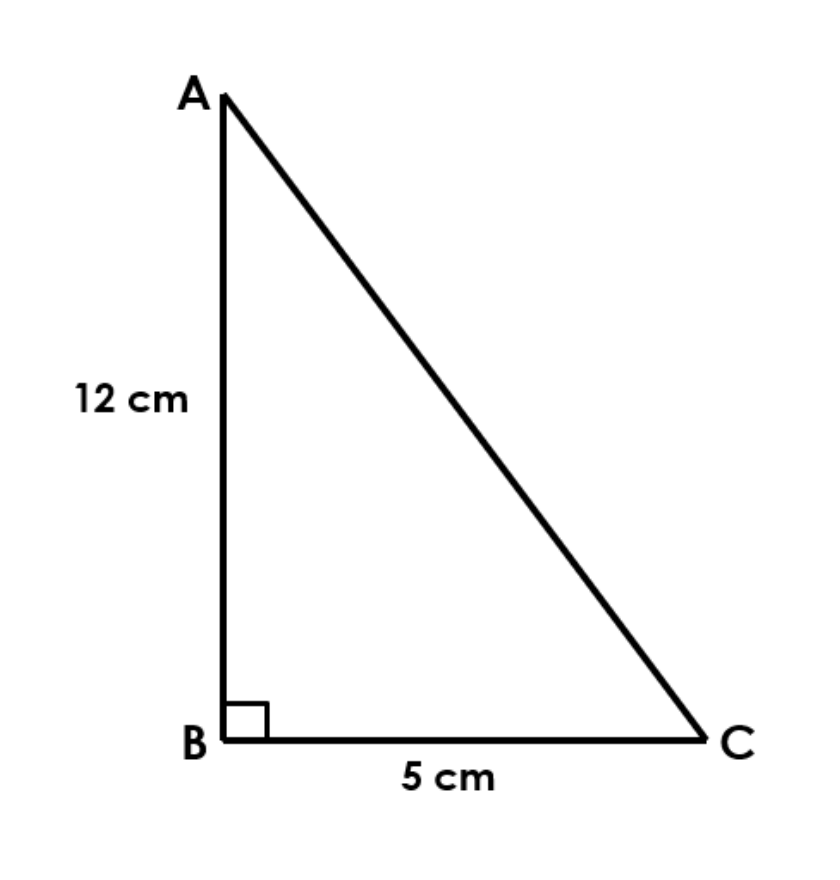
Official diagram: WC Overberg November 2025, Q3.1.
In the diagram, \(\triangle ABC\) is right-angled at \(B\), with \(AB=12\)cm and \(BC=5\)cm. Determine, correct to 2 decimal places where needed: (a) the length of \(AC\), (b) \(\sin\hat A\), (c) the size of \(\hat A\).
WC Overberg November 2025, Q3.1. Question, answer and marking points checked against the supplied marking guideline.
Diagram for this practice question; use the given values, not measurements from the screen.
In right-angled \(\triangle DEF\), the side opposite \(\hat D\) is \(8\) and the hypotenuse is \(17\). Determine \(\hat D\), correct to 1 decimal place.
Equation Station practice, not an official exam question.
Show worked solution
Worked solution
Working and reasons
Practice marks
\(\sin D=\dfrac{8}{17}\). Keep this fraction in your calculator.
Suggested practice allocation only. These marks are not copied from an official memo.
Q9L2: Routine procedures2 practice marks
Ladder Against a Wall
Diagram for this practice question; use the given values, not measurements from the screen.
A ladder leans against a wall, making an angle of \(65°\) with the ground. The foot of the ladder is \(2\)m from the wall. Determine the length of the ladder, correct to 2 decimal places.
Equation Station practice, not an official exam question.
Suggested practice allocation only. These marks are not copied from an official memo.
Q13L2: Routine procedures2 practice marks
Flagpole Shadow
Diagram for this practice question; use the given values, not measurements from the screen.
A flagpole casts a shadow of length \(15\)m when the angle of elevation of the sun is \(38°\). Determine the height of the flagpole, correct to 2 decimal places.
Equation Station practice, not an official exam question.
Suggested practice allocation only. These marks are not copied from an official memo.
Q14L2: Routine procedures3 practice marks
Angle of Depression
Diagram for this practice question; use the given values, not measurements from the screen.
From the top of a vertical cliff \(45\)m high, the angle of depression to a boat out at sea is \(22°\). Determine the horizontal distance from the base of the cliff to the boat, correct to 2 decimal places.
Equation Station practice, not an official exam question.
Show worked solution
Worked solution
Working and reasons
Practice marks
The angle of elevation from the boat equals the 22-degree angle of depression: the horizontal lines are parallel.
\(d\approx111.38\text{ m}\) (keep the calculator value of tan 22 degrees until the last step).
✓ 1
Total
3
Suggested practice allocation only. These marks are not copied from an official memo.
Q15L2: Routine procedures3 practice marks
Evaluating Beyond 90° With CAST
Without using a calculator, determine the value of \(\cos150°\), and hence write down the value of \(\cos330°\).
Equation Station practice, not an official exam question.
Show worked solution
Worked solution
Working and reasons
Practice marks
\(150°\) is in Q2, reference angle \(=180°-150°=30°\); cos is negative in Q2: \(\cos150°=-\cos30°=\boxed{-\dfrac{\sqrt3}{2}}\)
✓ 1
\(330°\) is in Q4, reference angle \(=360°-330°=30°\); cos is positive in Q4: \(\cos330°=\cos30°=\boxed{\dfrac{\sqrt3}{2}}\)
✓ 1
Both angles share the same reference angle \(30°\) — only the sign, decided by CAST, differs.
✓ 1
Total
3
Suggested practice allocation only. These marks are not copied from an official memo.
Q17L2: Routine procedures4 practice marks
Two Ratios, One Quadrant
Without using a calculator, determine the value of \(\sin225°\) and the value of \(\cos225°\).
Equation Station practice, not an official exam question.
Show worked solution
Worked solution
Working and reasons
Practice marks
\(225°\) is in Q3, reference angle \(=225°-180°=45°\)
✓ 1
In Q3, only tan is positive (CAST) — so both sin and cos are negative
✓ 1
\(\sin225°=-\sin45°=\boxed{-\dfrac{\sqrt2}{2}}\)
✓ 1
\(\cos225°=-\cos45°=\boxed{-\dfrac{\sqrt2}{2}}\)
✓ 1
Total
4
Suggested practice allocation only. These marks are not copied from an official memo.
L3
Complex procedures
2 questions
Q10L3: Complex procedures8 memo marks
Using the CAST Diagram, Given \(4\tan\theta=-3\)
If \(4\tan\theta=-3\) and \(\cos\theta\geq0\), without using a calculator, determine: (a) \(\sin\theta\), (b) \(10\cos^2\theta\), (c) \(3\cot\theta+5\sin\theta\).
KZN November 2024, Q4. Checked against marking-guideline pages 4-5. The CAST explanation is support, not an extra mark.
Show worked solution
Memo-aligned working
Working and reasons
Marks
CAST: tangent is negative and cosine is non-negative, so \(\theta\) is in Quadrant IV. Cosine cannot be zero because the given tangent is defined.
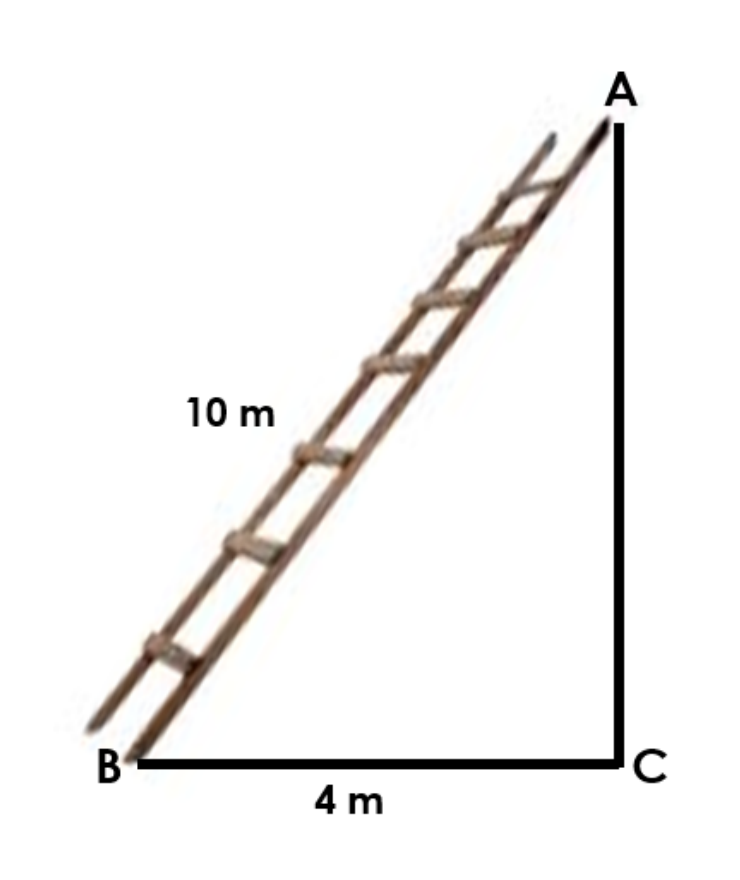
Official diagram: WC Overberg November 2025, Q4. The diagram shows the initial position only.
A ladder \(AB\), \(10\)m long, leans against a vertical wall. The foot of the ladder \(B\) is \(4\)m from the base of the wall \(C\). (a) Calculate the height \(AC\) that the ladder reaches up the wall. (b) Calculate the angle of elevation of the ladder, \(\angle ABC\). (c) If the ladder is moved so that it now makes an angle of \(75°\) with the ground, calculate how high up the wall it will now reach.
WC Overberg November 2025, Q4. Question, answer and marking points checked against the supplied marking guideline.